Key facts: Root Intrusion Removal
- Roots enter sewer laterals through joints and cracks that leak water, most often in older clay pipe [2].
- Citizens Energy Group says routine cleaning and root removal do not need a permit, while lining and repairs do [1].
- Cutting or jetting clears the bore, but roots usually regrow through the same joints unless they are sealed.
- A camera run after clearing shows where roots enter and whether the pipe is damaged.
How roots get in
Why tree roots end up inside a sewer lateral
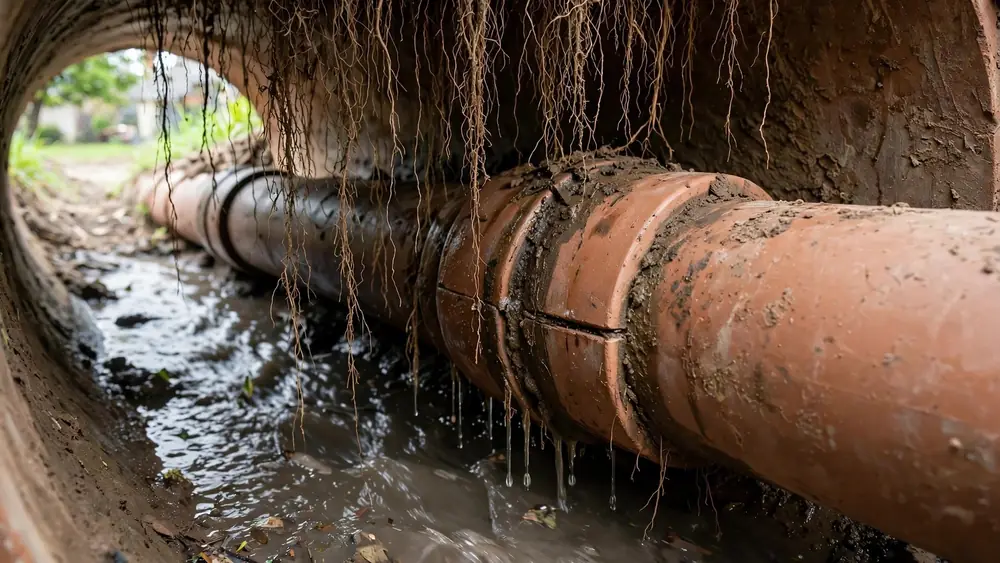
A sewer lateral is a steady source of warm water, oxygen and nutrients running a few feet under the lawn. In a sound pipe none of that escapes, and roots grow past it. In an older clay pipe, the joints between each short length were sealed with mortar or a packing that cracks and shrinks with age [2]. Vapor and a trickle of water leak out of those gaps, and fine feeder roots grow toward it.
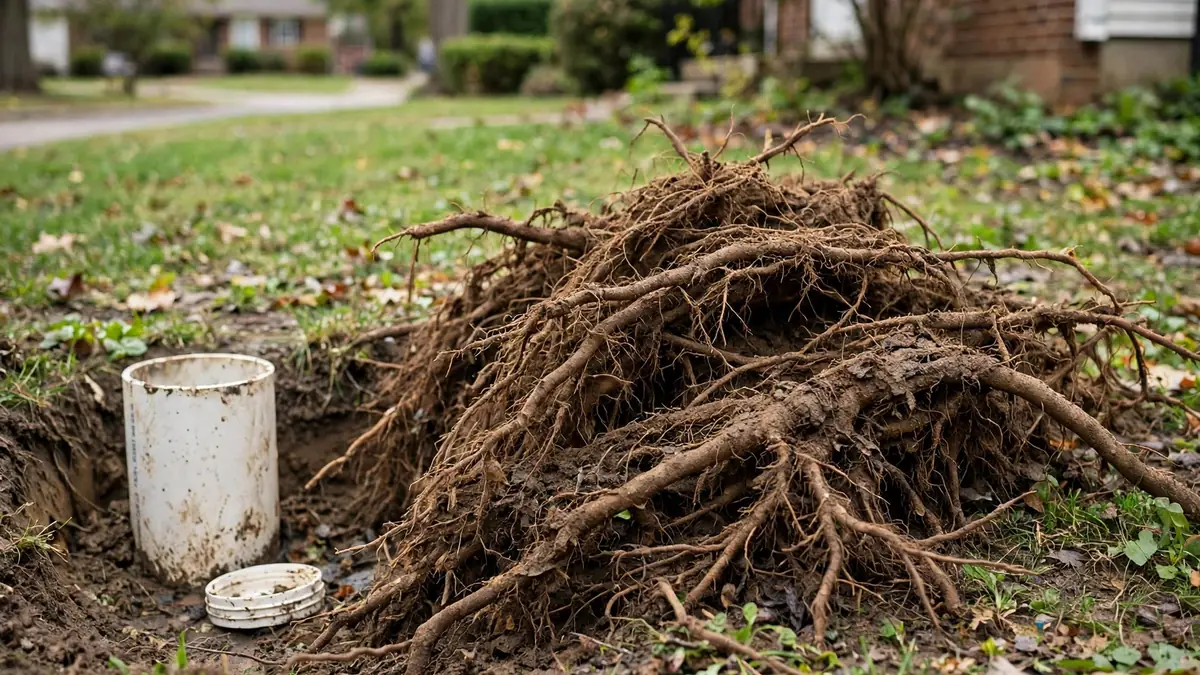
Once a hair-thin root slips through a joint, it is in a perfect environment. It branches into a dense, fibrous mat that fills the bore of the pipe. Toilet paper and grease catch in the mat, flow slows, and eventually the line backs up, usually at the lowest drain in the house. As the roots thicken over the years they can also pry the joint further apart or crack the pipe wall.
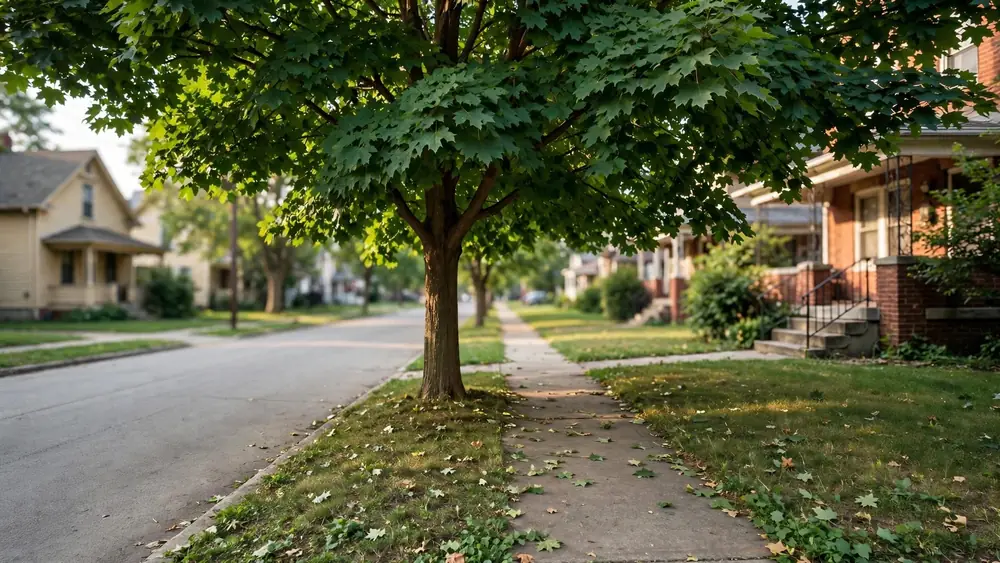
Indianapolis has a lot of the two ingredients that make this common: older laterals in clay or fiber pipe, and big trees. Many streets in neighborhoods built from the 1890s to the 1950s are lined with silver maples, sycamores, elms, oaks and honey locusts in the tree lawn between sidewalk and curb, which is often exactly where the lateral passes on its way to the main.
Warning signs
How root intrusion shows up in the house
Slow drains that get worse over months
Roots grow gradually, so the first sign is often a tub or basement drain that empties a little slower each week.
Gurgling toilets
Air trapped behind a root mat bubbles back through the toilet when other fixtures drain.
Backups after laundry
A washing machine dumps water fast; a partly blocked lateral sends it up the basement floor drain.
The same clog every year
Clearing works for a season or two, then the clog returns about the same time of year.
Lush grass over the line
A greener strip across the lawn in a dry spell can mean the lateral is leaking nutrients into the soil.
Roots wrapped around the drain cable
When a drain cable comes back wrapped in fine roots, there is no doubt about the cause.
Why it keeps happening
Why cutting roots alone rarely ends the problem
Clearing roots removes what is inside the pipe, not what is outside it. The root system that sent shoots into the joint is still alive in the soil, and the gap in the joint is still there. Within a growing season or two, new roots find the same opening, and the clog returns. Some homeowners in older neighborhoods have had the same lateral cleared every year for a decade.
Repeated cutting has a side effect. Each pass of a root-cutting blade can scrape the pipe wall and loosen a joint that was already marginal. Over many years, that can turn a joint with fine roots into an offset or a crack. That is why contractors generally recommend putting a camera in the line after the first clearing, rather than clearing it again and again without looking.
The lasting answers seal the joints. A full-length cured-in-place liner creates a jointless pipe inside the old one [4], and pipe bursting replaces the line with fused polyethylene that has no joints at all [5]. For a line with just one or two bad joints, a short sectional liner or a spot excavation may be enough.
Diagnosis
How a contractor checks for roots before and after clearing
- 1
Ask about the history
When did backups start, how often has the line been cleared, and are there big trees near the front of the house?
- 2
Test the drains
Running water at several fixtures shows whether the problem is the main line or one branch.
- 3
Open the cleanout carefully
A backed-up line can release water when the cap comes off, so it is opened slowly with a bucket ready.
- 4
Clear enough to film
A cutter or jetter opens the line so the camera can travel the full length.
- 5
Camera the whole lateral
The sewer camera inspection records where roots enter, how many joints are affected and whether the pipe is cracked.
- 6
Mark the root entry points
A locator marks the worst joints on the lawn, often right under or near a particular tree.
Reading the roots
Root findings and what they suggest
| What the camera shows | Likely situation | Common recommendation |
|---|---|---|
| A few hair roots at one or two joints | Early intrusion | Clear and recheck in a year or so |
| Heavy mat at one joint, pipe intact | Single failed joint | Clear, then sectional liner or spot repair |
| Roots at most joints along the run | Widespread seal failure | Full-length lining or replacement |
| Roots plus cracks or offsets | Structural damage from root pressure | Lining if round, otherwise bursting or digging |
| Roots plus standing water | Sag where debris settles | Excavate the sag; treat the rest |
| Roots at the main connection | Tap seal failure | Repair at the connection, often by excavation |
The job
How roots are removed from a lateral
- 1
Set up at the best access point
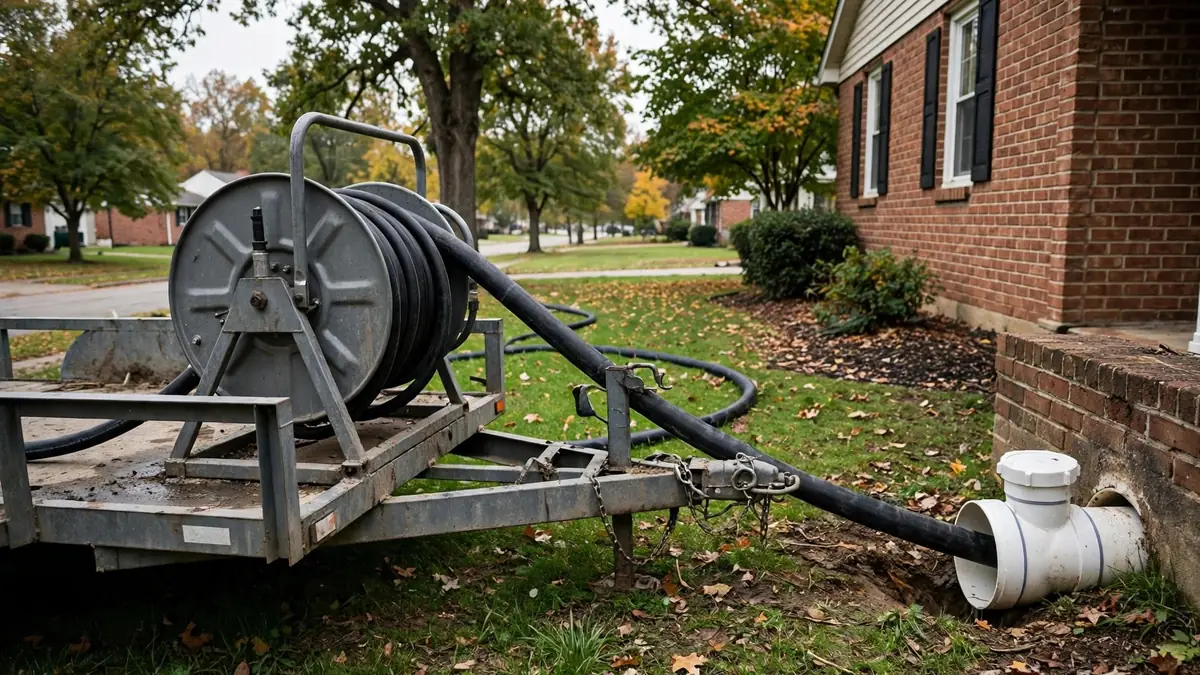
An outside or basement cleanout lets the tool go straight down the main line instead of through a toilet.
- 2
Choose the tool
A sectional or drum cable machine with a root-cutting head, or a hydro jetter with a root-cutting nozzle.
- 3
Cut in stages
The operator advances slowly, letting the cutter work through the mat rather than forcing it, to avoid damaging the pipe.
- 4
Flush the debris
Cut roots are flushed downstream to the main with plenty of water, or pulled back and removed.
- 5
Film the cleared line
A camera pass confirms the bore is open and records each joint where roots were entering.
- 6
Explain the options
The contractor walks you through the video and what it would take to stop the roots coming back.
Tools and methods
Root removal methods compared
| Method | What it does | Limits |
|---|---|---|
| Cable machine with root cutter | Spinning blades shear roots at the pipe wall | Leaves stubs; can scrape fragile pipe |
| Hydro jetting with root nozzle | High-pressure water and a spinning head cut and flush | Needs care in cracked or fiber pipe |
| Chemical root treatment | Foaming herbicide kills roots in the pipe | Slower; must be used per label; doesn't seal joints |
| Sectional liner | Seals one or two bad joints from inside | Only for short defects |
| Full-length liner | Seals every joint in the run | Pipe must be round and mostly intact |
| Pipe bursting or replacement | New jointless or gasketed pipe | Bigger job, but ends the joint problem |
DIY vs pro
What you can safely do about roots yourself
- Note which drains back up and when; the pattern helps the contractor.
- Stop using water as soon as the floor drain starts to rise.
- Avoid store-bought caustic drain openers in a main line; they rarely reach a root mat and are dangerous if the line has to be opened.
- Copper sulfate and foaming root products are sold for this use, but follow the label exactly and check local rules before putting chemicals into the sewer.
- Do not rent a powerful drain machine for a root-filled clay line; a cable can kink, lodge or break pipe.
- Find out where the lateral runs before planting new trees, and keep them well away from it.
- Ask any contractor you hire for the camera video, not just a cleared drain.
- Lateral repairs require a licensed contractor in Indianapolis, so leave anything beyond clearing to them [1].
The visit
What to expect when the contractor arrives for roots
Most root clearing visits on a single-family house take one to two hours, longer if the cleanout is seized, the line is very full, or a camera run and locating are included. The contractor will need access to the cleanout, which in many older Indianapolis houses means the basement, and space to set up a machine nearby.
Expect some mess around the cleanout when it is opened on a full line. Contractors usually lay down tarps and have a wet vac, but it helps to move stored items away beforehand. Once the line is open, water already backed up in the house drains away quickly.
If the contractor recommends a lining or replacement after seeing the video, that is a separate job with a Citizens Energy Group permit [1]. Ask for the video either way, so you can compare it with the next inspection or share it for a second opinion.
Local specifics
Roots, street trees and laterals in Indianapolis
Root problems cluster in the neighborhoods that were built when clay was the standard lateral material, which in Indianapolis includes most of the city inside the old pre-1970 boundaries: places like Irvington, Meridian-Kessler, Butler-Tarkington and Garfield Park. These are also some of the city's leafiest streets, and the trees in the tree lawn sit almost on top of the sewer route.
Citizens Energy Group, which operates the city's wastewater system, makes clear that the lateral from the home to the main is the property owner's to maintain, and that routine cleaning and root removal can be done without a permit, while lining, repair and replacement require one [1]. That puts root removal in the homeowner's hands and makes it something you can schedule as maintenance before the next backup.
Central Indiana soils are rich in clay and hold moisture, which encourages roots to stay near the surface and close to the lateral. Wet springs often bring a wave of root-related backups as trees push out new growth. If your line has been cleared before, late winter or early spring is a sensible time to have it checked.
Prevention
Keeping roots out of the line between visits
- Schedule clearing before the season the line usually clogs, not after the backup.
- Keep grease, wipes and paper towels out of the drains so the root mat has less to catch.
- Choose smaller, less aggressive trees for spots near the lateral; ask a nursery about root habits.
- Do not plant willows, poplars or silver maples near a known sewer route.
- Consider lining or replacing the joints that keep letting roots in rather than cutting them indefinitely.
- Keep a record of each clearing and video so you can see whether the problem is getting worse.
Clear or fix
When to stop cutting roots and seal the line
Root clearing is maintenance; sealing the joints is repair. If a line clogs once every few years and the camera shows a round pipe with light roots at a couple of joints, periodic clearing may be reasonable for a long time. If the line clogs every year, roots are at most joints, or the camera shows cracks and offsets, sealing the line is usually the better long-term answer.
The choice between lining and replacing depends on the pipe's shape and grade. A round clay line with roots at the joints is a good lining candidate. A fiber pipe that has gone oval, a line with sags, or one with several broken sections usually points toward sewer line replacement by bursting or open trench. The tree roots guide goes through these trade-offs in more depth.
Trees and neighbors
When the problem tree isn't yours
Roots do not respect property lines. The tree causing the trouble may be a neighbor's, or a street tree in the public tree lawn. Your lateral is still yours to maintain, so the practical response is the same: clear the line, film it, and decide whether to seal the joints. A camera locate that shows roots entering right beside a particular tree is useful information if you want to talk with a neighbor or ask about the street tree.
Avoid cutting major roots of a large tree yourself to protect a sewer. Severing big roots close to the trunk can destabilize a tree or kill it, which creates a bigger hazard than the clog. If a replacement trench must pass near a significant tree, ask the contractor about routing, tunneling under the root zone or using bursting to avoid open cutting. An arborist can advise on how much root loss a tree can tolerate.
Seasons
How the time of year changes root clogs
Root clogs in central Indiana often follow the calendar. Trees push out new feeder roots in spring as the soil warms and moisture is plentiful, and a lateral that drained slowly over the winter can block completely in April or May. Late summer droughts bring a second wave, when trees go looking for water and a leaking joint becomes the best source within reach.
Winter does not stop root growth underground, but it slows it, and frost in the upper soil can shift shallow joints. Sewer laterals in older Indianapolis houses usually run deeper than the frost line near the house, though the depth can vary along the run and shallower sections near the street are more exposed to freeze and thaw movement.
If your line has a history, use that pattern. A clearing scheduled a few weeks before the usual trouble season is far less disruptive than a basement full of water on a holiday weekend. Keep a simple log of dates, what was done and what the camera showed; after two or three years it will tell you whether maintenance is keeping up or the line needs sealing.
On the call
Details that help the contractor plan a root visit
- Where the cleanout isBasement floor, front wall, outside near the foundation, or no known cleanout at all.
- When the line was last clearedAnd whether roots came back on the cable or were mentioned on the invoice.
- Which trees are near the frontSpecies if you know it, and roughly how far from the house and the street.
- Whether water is standing nowA full line changes how the cleanout is opened and how long clearing takes.
- Any earlier videoAn old inspection is a useful comparison to see how fast roots are returning.
After clearing
The first few days after roots are cut
Right after clearing, drains should run freely. Cut root fragments sometimes catch further down the line in the first day or two, so run plenty of water after the visit and watch the floor drain. If the line slows again within days rather than months, call back: it may mean a fragment lodged at a sag or the main connection, or that the cutter did not reach the full length.
Related problems
Problems that travel with root intrusion
A root-blocked lateral is the most common cause of a sewer backup into an Indianapolis basement. Roots can also crack pipe and open the way for soil to wash in, leading to the sagging lawn and odors described in the sewer smell in the yard guide.
FAQ
Root removal questions for Indianapolis sewers
How often should roots be cleared from a sewer line?
It depends on how fast they regrow. Many root-prone clay laterals need clearing every one to two years. If yours needs it more often, sealing the joints with a liner or replacing the line is usually the better plan.
Do I need a permit to have roots removed from my sewer in Indianapolis?
No. Citizens Energy Group lists routine cleaning and root removal as work that does not need a permit. Lining, repairs and replacement of the lateral do.
Will root killer fix my sewer line?
Root-killing products can slow regrowth when used as directed, but they do not repair the cracked joints roots use to get in. They work best as a supplement to mechanical clearing, not a replacement for it.
Can roots break a sewer pipe?
Roots usually enter through existing gaps, but as they grow they can widen joints and crack weakened clay or fiber pipe. That is why a camera check after clearing is worth doing.
Is hydro jetting better than cutting roots?
Each has a place. Jetting with a root nozzle cleans the pipe wall more thoroughly and flushes debris, while a cable cutter is quick for opening a blocked line. The pipe's condition decides which is safer.
Which trees cause the most sewer root problems?
Fast-growing, water-seeking trees such as willows, poplars and silver maples have a reputation for it, but almost any large tree near a leaking clay lateral can send roots in.
Does lining stop roots?
A properly installed full-length liner has no joints for roots to enter. Roots may still reach unlined parts of the line or the ends, so the final video should show the liner covering the problem joints.
Should I remove the tree to save the sewer?
Not usually. Sealing or replacing the pipe is generally a better answer than losing a mature tree, and cutting big roots can make a tree unstable. Talk with an arborist before removing or root-pruning a large tree.