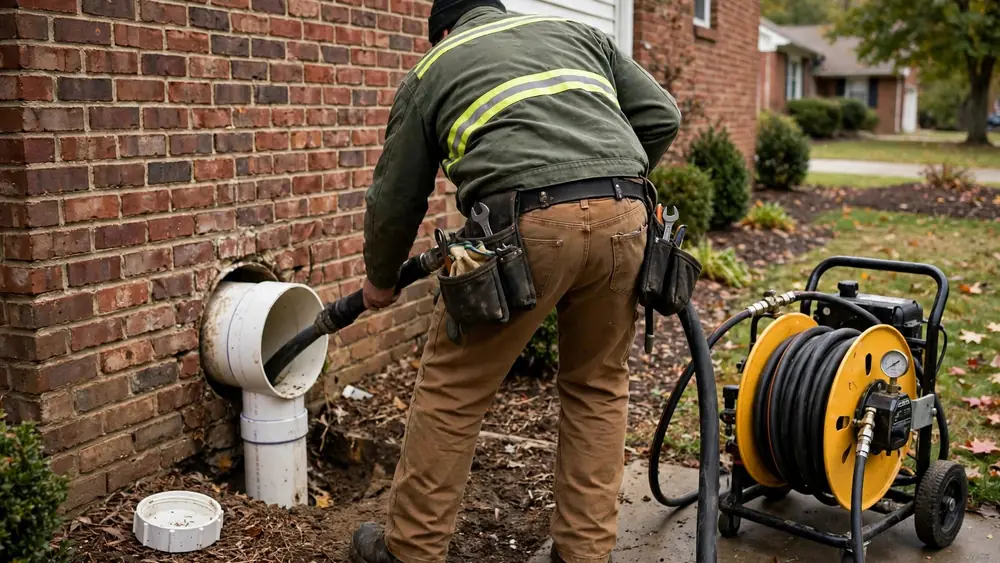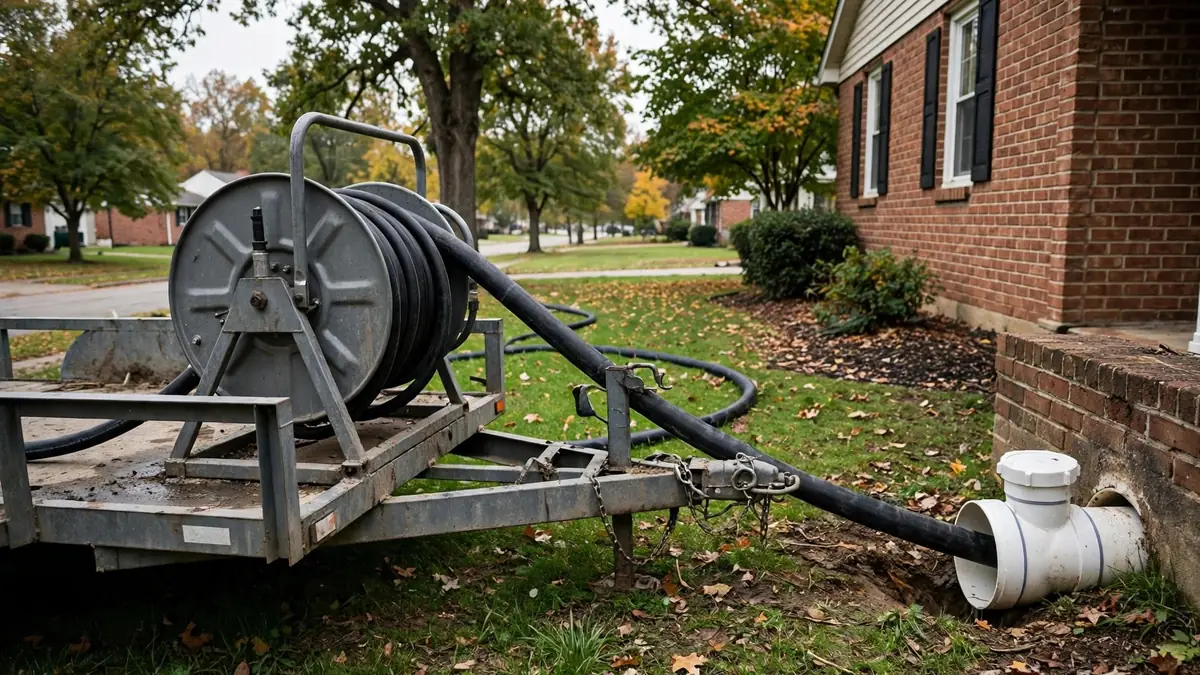
Key facts: Hydro Jetting
- Hydro jetting cleans a sewer by forcing high-pressure water through rear-facing nozzles that propel the hose and scour the pipe wall [2].
- Cleaning and root removal do not need a Citizens Energy Group permit in Indianapolis [1].
- Jetting is the standard preparation before a cured-in-place liner, which needs a clean wall to bond to.
- Badly cracked clay or deformed fiber pipe may be too fragile to jet at full pressure, so a camera look first is prudent.
How it works
What a sewer jetter does inside the pipe
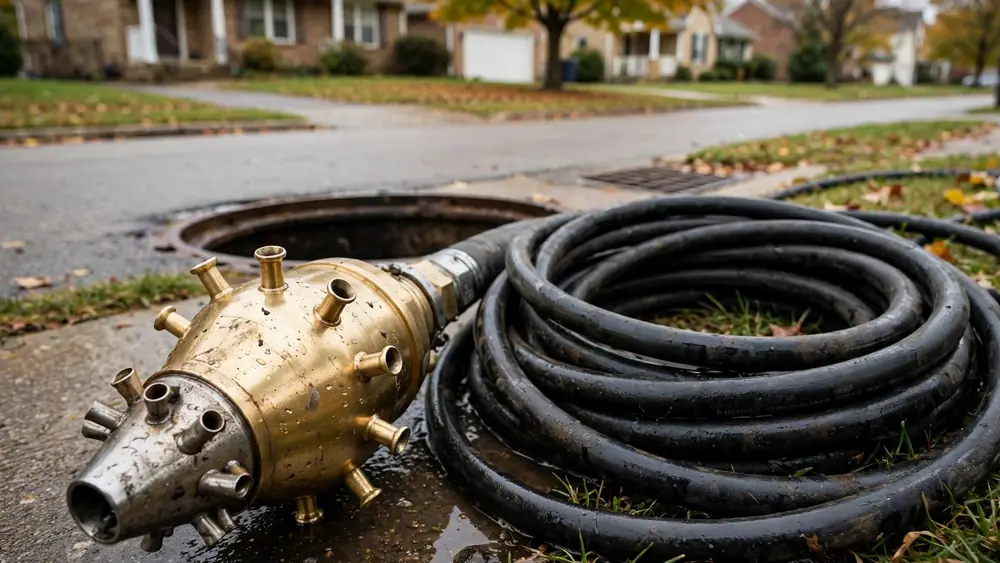
A sewer jetter is a pump, a water supply, a reel of high-pressure hose and a set of nozzles. The nozzle has one or more jets pointing forward to break through blockages and several pointing backward. The backward jets do most of the work: they push the nozzle forward down the line and at the same time sweep the pipe wall with water as it travels [2]. When the operator pulls the hose back, those jets scour the wall again and carry loosened debris downstream toward the main.
That combination is what makes jetting different from a cable machine. A cable punches a hole through a clog and scrapes some of the wall, but grease, scale and root hairs often remain on the sides of the pipe, ready to catch the next load of paper. A jet cleans the full circumference of the pipe and flushes the material away, so the line is restored closer to its original diameter.
Contractors can change nozzles for different jobs. A penetrating nozzle drives through a hard blockage, a flushing nozzle with wide-angle jets cleans the wall, and a spinning or chain-type root nozzle cuts roots at the joints. Residential laterals in Indianapolis are typically four or six inches across, so equipment is sized for that, not for the much larger public mains.
When it helps
Problems hydro jetting handles well
Grease-coated lines
Kitchen grease hardens on the pipe wall and narrows it over years; jetting strips it out in a way a cable cannot.
Fine roots at joints
Root nozzles cut the hair-like roots that slip through clay joints, as part of root intrusion removal.
Scale in cast iron
Rough corrosion scale under basement floors catches paper; specialty heads can descale it.
Sand and silt
Debris that washed in through a defect can be flushed out so the camera can see the break.
Liner preparation
A cured-in-place liner needs a clean wall; jetting is the usual prep step.
Repeated slow drains
Lines that clog every few months after cabling often stay open longer after a thorough jetting.
Why lines get coated
What builds up inside an Indianapolis lateral
Grease is the most common culprit in lines that are otherwise intact. Cooking fat, oil and grease pour down a drain as a liquid but cool and solidify as they travel through a cold pipe, sticking to the walls and binding with soap residue and food particles. The EPA identifies grease as a leading cause of sewer blockages and overflows in public systems [5], and house laterals suffer the same way on a smaller scale.
In older laterals, the pipe itself adds to the problem. Clay pipe has a joint every few feet, and each slightly offset joint is a ledge where paper and grease collect [3]. Cast iron under basement floors corrodes and develops a rough, bumpy scale inside. Both give buildup something to grip, which is why a clay or cast iron line can narrow faster than a smooth plastic one.
Wipes make everything worse. Products labeled flushable do not break apart the way toilet paper does, and they snag on roots, scale and grease, forming dense plugs. Many jetting calls are for lines where years of grease and a few weeks of wipes have finally met.
Checks first
How a contractor decides if a line can be jetted
- 1
Ask about the pipe
Age of the house, past repairs and any earlier inspection video give a first idea of the material.
- 2
Open the line if it's backed up
A cable may be used first to relieve standing water so the camera can see.
- 3
Look before jetting
A quick camera inspection shows collapses, big cracks or deformed fiber pipe.
- 4
Pick pressure and nozzle
Sound pipe gets a full cleaning; fragile sections get lower pressure or a different method.
- 5
Plan the entry point
An outside cleanout is ideal. Jetting from a basement cleanout needs care to avoid blowback.
- 6
Confirm the water supply
Jetters use a lot of water, usually from an outside spigot or a tank on the truck.
Matching the tool
Jetting versus cabling for common lateral problems
| Problem | Cable machine | Hydro jetter |
|---|---|---|
| Sudden clog from paper or wipes | Quick to open the line | Clears and flushes it fully |
| Grease coating the walls | Pokes a hole through it | Strips it from the wall |
| Fine roots at joints | Cuts a path through | Cuts and flushes, cleaner result |
| Heavy root ball | Root saw often used first | Follow-up to clean the wall |
| Fragile or cracked pipe | Lower risk if used gently | Use with caution or avoid |
| Preparing for lining | Not enough on its own | Standard preparation |
The job
What happens during a jetting visit
- 1
Set up the jetter
Cart or trailer jetters park near the cleanout; the hose is fed in by hand or from a reel.
- 2
Feed the nozzle to the main
The operator lets the nozzle pull itself down the line, pausing at obstacles.
- 3
Work the trouble spots
At joints with roots or heavy grease, the hose is worked back and forth to clean them thoroughly.
- 4
Pull back slowly
On the return, the rear jets scour the wall and push debris toward the main.
- 5
Change nozzles if needed
A root cutter or descaling head may follow the first pass.
- 6
Film the result
A final camera run shows the cleaned line and any structural defects that were hidden by buildup.
Nozzle types
Jetter heads used on house sewers
| Nozzle | Purpose | Notes |
|---|---|---|
| Penetrating (bullet) nozzle | Breaks through hard blockages | Forward jet opens the line |
| Flushing nozzle | Cleans walls and moves debris | Wide rear jets for scouring |
| Rotating nozzle | Even cleaning of grease and scale | Spinning jets cover the full wall |
| Root-cutting head | Cuts roots at joints | Spinning blades or chains driven by water |
| Descaling head | Removes corrosion in cast iron | Used carefully on thin-walled pipe |
DIY vs pro
What not to try with a rented or pressure-washer jetter
- Pressure-washer drain attachments are sold for small lines, but a main lateral full of roots or grease is beyond them.
- Never jet into a line that is backed up into the house without a way for water to escape; it can blow back through floor drains.
- Do not jet a line you suspect is broken; high pressure can wash soil into the pipe or worsen a crack.
- Do keep a strainer in kitchen sinks and wipe greasy pans into the trash before washing.
- Do keep wipes, paper towels and cotton products out of toilets.
- Do ask the contractor what pressure and nozzle they used and why.
- Do ask for the camera video after jetting to see the pipe's true condition.
- Leave repairs found during jetting to a licensed contractor with a Citizens permit [1].
The visit
A typical hydro jetting appointment
A jetting visit on a single-family Indianapolis lateral usually takes one to three hours, depending on how much buildup there is, how long the line is and whether a camera run is included. The contractor needs access to a cleanout and often to an outside hose bib for water, unless the truck carries its own tank.
Jetting is noisy outside where the pump runs, and you may hear water moving through the pipes inside. If the contractor is working from a basement cleanout, they will protect the area with tarps and keep the cap ready in case water surges back. You will be asked not to run water during the work.
At the end, expect a walkthrough of the video if one was taken. Grease and roots often hide cracks, offsets and sags, so a line that looked like a simple clog can reveal a structural problem once it is clean. That is not a bad outcome: it is information you need to plan the next step.
Local specifics
Jetting laterals in older Indianapolis neighborhoods
The age of much of the city's housing makes the camera-first approach especially sensible here. In neighborhoods developed from the late 1800s to the 1950s, laterals are often vitrified clay [3], and post-war homes may have sections of fiber pipe that soften and deform with age [4]. A jet run at full pressure through a sound clay line is routine; the same run through a cracked joint or an oval fiber section can wash soil into the pipe or break off fragments.
Citizens Energy Group classes routine cleaning and root removal as work that does not need a permit [1], which keeps jetting simple to arrange. If the video afterwards shows a defect that needs repair, lining or replacement, that next job does require a permit and inspection [1].
Water supply is another local detail. Jetters draw a lot of water, typically through a garden hose from an outside spigot. In winter, outside spigots may be shut off, so contractors either bring water on the truck or connect inside. It helps to mention the season and your spigot situation when you call.
Prevention
Keeping a jetted line clean longer
- Wipe grease and food scraps from pans into the trash before washing.
- Use sink strainers and empty them into the trash.
- Run hot water and a bit of dish soap after washing greasy dishes, but do not rely on it to keep grease moving for long.
- Only flush toilet paper; bin everything else.
- If roots were found, plan follow-up jetting or a liner before they regrow.
- Keep the jetting video so the next contractor can compare.
Clean or repair
When jetting is enough and when it only buys time
For a structurally sound line that is simply coated with grease, scale or debris, jetting can be the whole answer, combined with better drain habits. For a clay line with roots at a few joints, jetting is good maintenance but not a cure; the roots return through the same gaps. For a line with cracks, offsets, sags or collapses, jetting is a diagnostic step that lets the camera see the damage.
When the video after jetting shows defects, the usual next steps are a trenchless repair for a round pipe with joint problems, or sewer line replacement for broken, sagging or deformed pipe.
Restaurants and buildings
Jetting for small commercial and multi-unit buildings
Small apartment buildings, mixed-use storefronts and older converted houses in places like Broad Ripple and Fountain Square often have heavier grease loads than a single family home, especially where a kitchen shares a lateral with apartments above. Those lines may need jetting on a regular schedule rather than only when they clog. Commercial kitchens are also usually expected to maintain grease interceptors, which a contractor can inspect while on site.
For any building with several units, coordinate the visit so tenants know not to use water during the work, and ask the contractor to record the line's condition so you have a baseline for the next service.
Basement entry
Jetting from a basement cleanout in an older house
Many Indianapolis houses built before the 1950s have only one cleanout, and it is inside: a cast iron fitting near the front foundation wall, a few inches above the basement floor. Jetting from there works, but it takes more care than jetting from an outside cleanout. The hose runs across the basement, the water supply has to reach it, and if the line ahead is blocked, water and debris can push back out of the opening.
Experienced operators handle this by relieving any standing water first with a cable, using a guide tube or blowback shield at the cleanout, and feeding the nozzle until it is well past the foundation before bringing the pump to full pressure. They protect the floor with tarps and keep a wet vac running. It is also a good moment to look at the cleanout fitting itself, since an old cast iron plug that is cracked or seized is worth replacing.
If your house has no usable cleanout, the contractor may suggest installing an outside two-way cleanout as part of a later repair. That moves future jetting and camera work outdoors, which is quicker, cleaner and easier on the basement. Adding a cleanout is lateral work that needs a Citizens permit [1].
Telling it apart
Signs the problem is buildup rather than a broken pipe
- Gradual slowdownDrains that slow over months, not suddenly, fit grease or scale narrowing the pipe.
- Greasy residue on the cableIf a previous cabling came back coated in gray or white grease, buildup is a large part of the problem.
- Kitchen drain worstTrouble that starts at the kitchen sink and spreads points to grease from cooking.
- No yard symptomsNo wet spots, sinkholes or sewage smell outside suggests the pipe itself may still be intact.
- Clean return after jettingDrains that run fast for a long time after jetting suggest buildup was the main cause.
After jetting
What a clean line on camera tells you
A clean pipe is the best canvas for a camera. After jetting, the contractor can see each joint, the true diameter, any cracks and the exact transition points between materials. That is when decisions about lining or replacement become clear, because nothing is hidden under grease or roots.
Ask the contractor to point out anything that worried them on the video and to note the footage. Even if nothing needs fixing now, the record is valuable: the next time the line slows, a fresh video can be compared side by side to see what has changed.
Winter jobs
Jetting a lateral in an Indianapolis winter
Cold weather changes the logistics more than the method. Outside hose bibs are often shut off and drained for the season, hoses can freeze on the ground, and water left on a driveway turns to ice. Contractors working in winter commonly bring heated water tanks on the truck, keep hoses on a reel instead of lying in the yard, and run from a basement cleanout when the outside one is buried under snow. Mentioning the weather and where your water supply is helps them arrive prepared, and clearing a path to the cleanout saves time on a cold morning.
Questions to ask
Three things to ask before the jetter starts
Ask whether the contractor will look with a camera before or after jetting, which nozzle and pressure they plan to use for your pipe material, and where the debris will end up. A clear answer to each shows they have thought about your specific line rather than running the same routine on every house.
FAQ
Hydro jetting questions from Indianapolis homeowners
Is hydro jetting safe for old clay sewer pipes?
For clay pipe in decent condition, yes, when the operator chooses suitable pressure and nozzles. Badly cracked or broken sections can be damaged further, which is why many contractors look with a camera before jetting at full pressure.
How often should a sewer line be jetted?
There is no single schedule. A line with heavy grease or recurring roots may need jetting every year or two; a sound line with good drain habits may never need it. Past video helps set a sensible interval.
Is hydro jetting better than snaking?
Jetting cleans the full pipe wall and flushes debris, while snaking mainly punches through a clog. For grease, scale and fine roots, jetting usually gives a longer-lasting result; for a quick opening, a cable is often used first.
Does hydro jetting need a permit in Indianapolis?
No. Citizens Energy Group lists routine cleaning and root removal as work that does not require a permit. Repairs or lining found necessary afterwards do.
Can jetting remove tree roots completely?
Jetting with a root nozzle cuts roots inside the pipe, but the roots outside and the gaps they used remain. Sealing the joints with a liner or replacing the pipe is what stops them coming back.
Will jetting fix a sewer smell?
Only if the smell comes from buildup in the line. Odors from a broken pipe, a dry trap or a vent problem need a different fix.
How much water does hydro jetting use?
A noticeable amount, typically drawn through a garden hose at several gallons per minute for the length of the job. It all goes down your sewer to the main.
Can grease be jetted out of the line for good?
Jetting removes what is there now. Keeping grease out of the drains afterwards is what keeps the line clear.