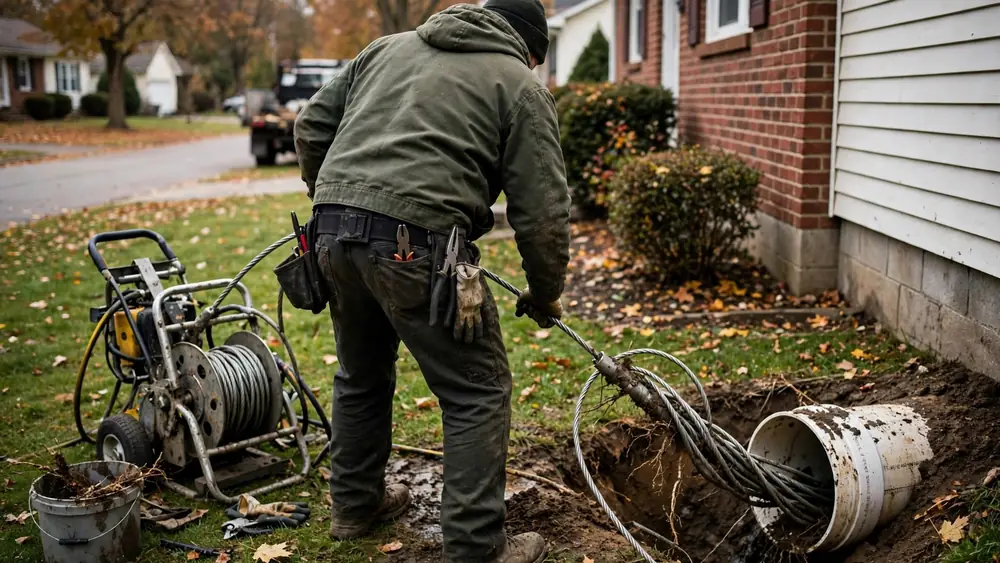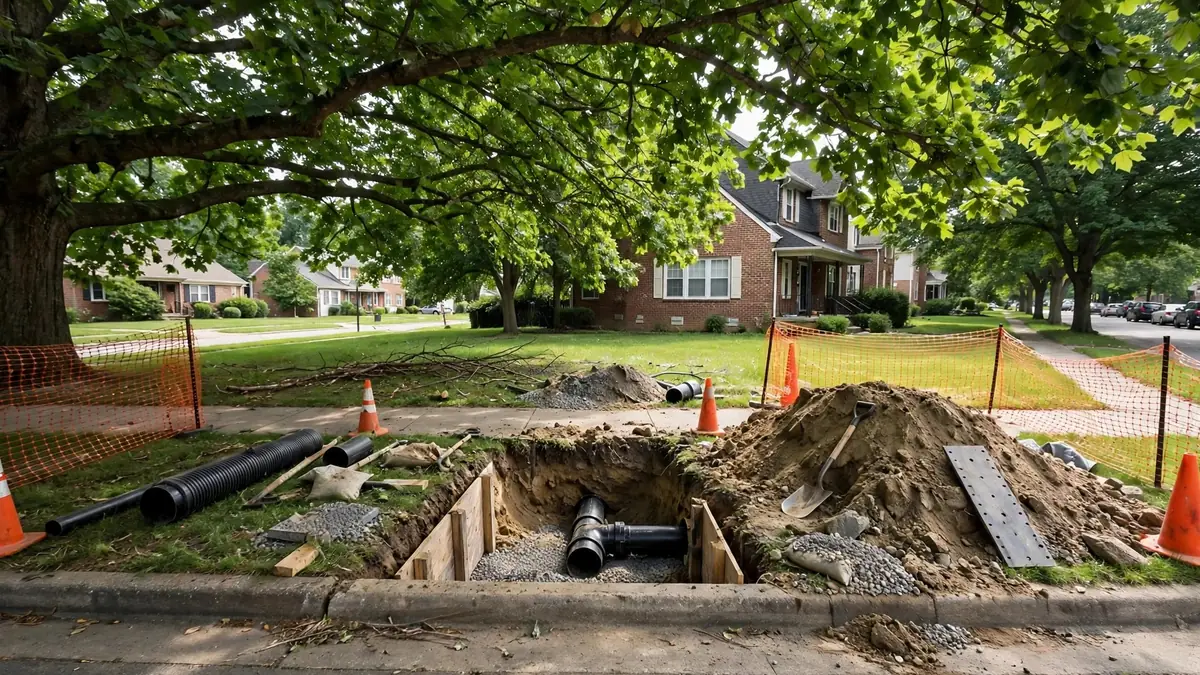
Key facts: Tree roots in the sewer line
- Roots enter laterals through leaking joints and cracks, most often in older clay pipe [2].
- Clearing removes roots inside the pipe, but they usually regrow through the same gaps.
- Lining or jointless replacement pipe removes the gaps roots use [3][4].
- Citizens Energy Group lets root removal proceed without a permit; lining and replacement need one [1].
How it starts
From a leaking joint to a root mat
Older clay laterals are built from short lengths joined at bells, and the original joint seals crack and shrink with age [2]. A small amount of water vapor and moisture escapes, and feeder roots in the surrounding soil grow toward it. Once a fine root slips into the joint, it finds water, nutrients and air, and it thrives.
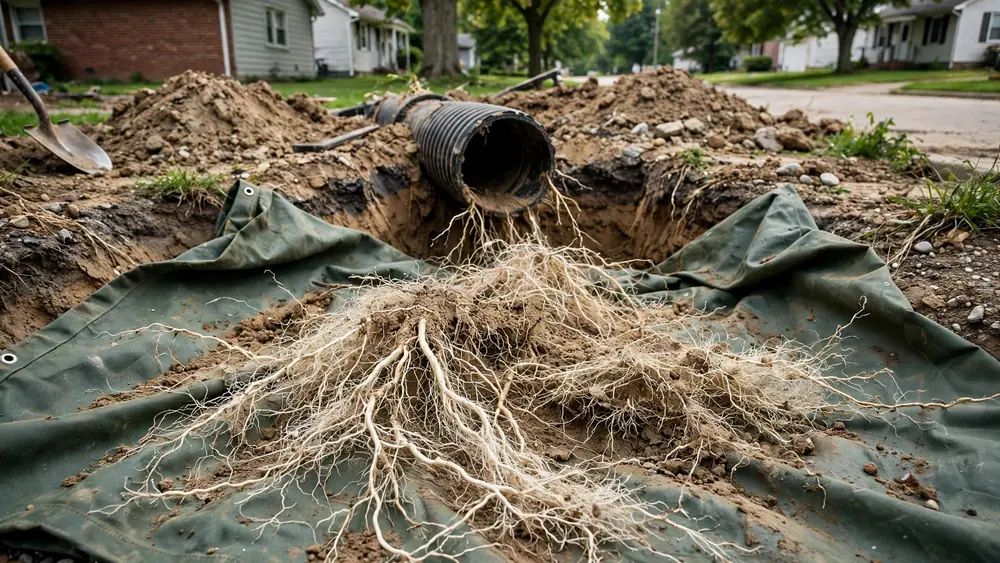
Over a season or two, that root branches into a dense curtain hanging into the flow. Paper and grease catch on it, the opening narrows, and drains slow. As the roots thicken over the years they can widen the joint or crack the pipe, which lets in more roots and soil.
Signs
How roots announce themselves
- Gradual slowdownDrains get slower over weeks or months rather than stopping suddenly.
- Seasonal clogsBackups that recur around the same time each year, often spring.
- Gurgling toiletsAir pushed back through the bowl when other fixtures drain.
- Roots on the cableA drain cable that comes back wrapped in fine roots is definitive.
- Big trees near the routeTrees in the front yard or tree lawn over an older lateral are the usual source.
Options
Managing roots versus keeping them out
| Approach | What it achieves | Trade-off |
|---|---|---|
| Periodic cutting or jetting | Opens the line for a season or two | Roots return through the same joints |
| Root-killing treatment after clearing | Slows regrowth when used per label | Does not seal joints; repeat treatments |
| Sectional liner | Seals one or two bad joints | Other joints may fail later |
| Full-length liner | Seals every joint in the run | Needs a round, cleanable host pipe |
| Pipe bursting or replacement | New jointless or gasketed pipe | Larger job; some excavation |
Choosing
When to stop cutting and start sealing
If your line clogs every few years and the camera shows light roots at a couple of joints in a round pipe, regular root intrusion removal may be a reasonable plan for some time. If it clogs every year, roots are at most joints, or the video shows cracks and offsets, sealing the line is usually the better choice.
A full-length CIPP liner creates a continuous wall with no joints [3], which is why it is so widely used on root-prone clay. Pipe bursting pulls in fused polyethylene with no joints at all [4], and is often chosen when the old pipe is deformed. Sags still need excavation.
Plan
A sensible order of operations for a root problem
- 1
Clear the line
Cut or jet the roots so water can flow and the camera can see.
- 2
Film it to the main
Record where roots enter, how many joints are affected and whether the pipe is damaged.
- 3
Mark the entry points
The locator shows which joints, and which trees, are the problem.
- 4
Decide: manage or seal
Light, occasional roots may be managed; widespread or structural damage points to lining or replacement.
- 5
Permit and repair
Lining or replacement goes through a Citizens Energy Group permit and inspection [1].
Trees
Keeping the tree and fixing the pipe
Removing a mature tree is rarely necessary to fix a sewer, and cutting large roots near the trunk can destabilize it. Trenchless methods let you seal or replace the lateral without digging through the root zone. When you plant new trees, keep them away from the sewer route you now know from the camera locate, and favor species with less aggressive roots near the line.
In Indianapolis, many older streets have large trees in the tree lawn right over the lateral's path. The trees are an asset; a jointless pipe lets you keep them without the yearly backup.
Seasons
Why root clogs follow the calendar
In central Indiana, trees push out new feeder roots as the soil warms in spring, and a lateral that drained sluggishly all winter can block in April or May. Dry late summers bring a second wave, when roots go looking for water and a leaking joint is the best supply nearby. If your line has a history, schedule clearing a few weeks before your usual trouble season rather than waiting for the backup.
Keep a simple log of each clearing, what came out on the cable and what the camera showed. After two or three entries, the log tells you whether maintenance is keeping up or whether the roots are winning and it is time to seal the joints.
Prevention
Habits that make root problems less painful
- Keep grease, wipes and paper towels out of the drains so a small root mat has less to catch.
- Know your lateral's route from the camera locate and keep new trees away from it.
- Ask a nursery about root habits before planting near the front of the house.
- Keep the cleanout reachable so clearing is quick when needed.
- Keep every video; comparing them shows how fast roots are returning.
Indianapolis streets
Roots on older Indianapolis streets
Neighborhoods built from the late 1800s to the 1950s, such as Irvington, Meridian-Kessler and Garfield Park, combine clay laterals with large trees in the tree lawn. That is why root clogs are among the most common sewer calls in the older city. Newer subdivisions with plastic pipe see far fewer, though sags and damaged connections can still trap debris that roots then exploit.
Permits
Permits for root work in Indianapolis
Clearing roots needs no permit under Citizens Energy Group rules; lining or replacing the lateral does [1].
FAQ
Tree root sewer questions
Can tree roots break a sewer pipe?
Roots mostly enter through existing gaps, but as they grow they can widen joints and crack weak clay or fiber pipe. That is why a camera check after clearing is worthwhile.
How often do roots need to be cleared?
Many root-prone clay lines need clearing every one to two years. If yours needs it more often, sealing the joints is usually the better plan.
Do root killers work?
Used as directed after mechanical clearing, they can slow regrowth. They do not seal the joints, so roots usually come back eventually.
Will lining stop roots permanently?
A properly installed liner has no joints for roots to enter along its length. Unlined sections and the liner ends remain possible entry points.
Should I cut down the tree?
Usually not. Fixing the pipe is generally a better answer than losing a mature tree. Ask an arborist before removing or root-pruning a large tree.