Key facts: Trenchless Sewer Repair
- Trenchless sewer repair replaces the flow path of a lateral through small access points instead of a continuous trench.
- Citizens Energy Group lists lining as work that needs a permit in Indianapolis, the same as a dug repair [1].
- Cured-in-place lining forms a new resin pipe inside the old one; pipe bursting breaks the old pipe outward while pulling a new one in [2][3].
- Sags, fully collapsed sections and some failed connections still need excavation.
How it works
Two ways to rebuild a lateral without a long trench
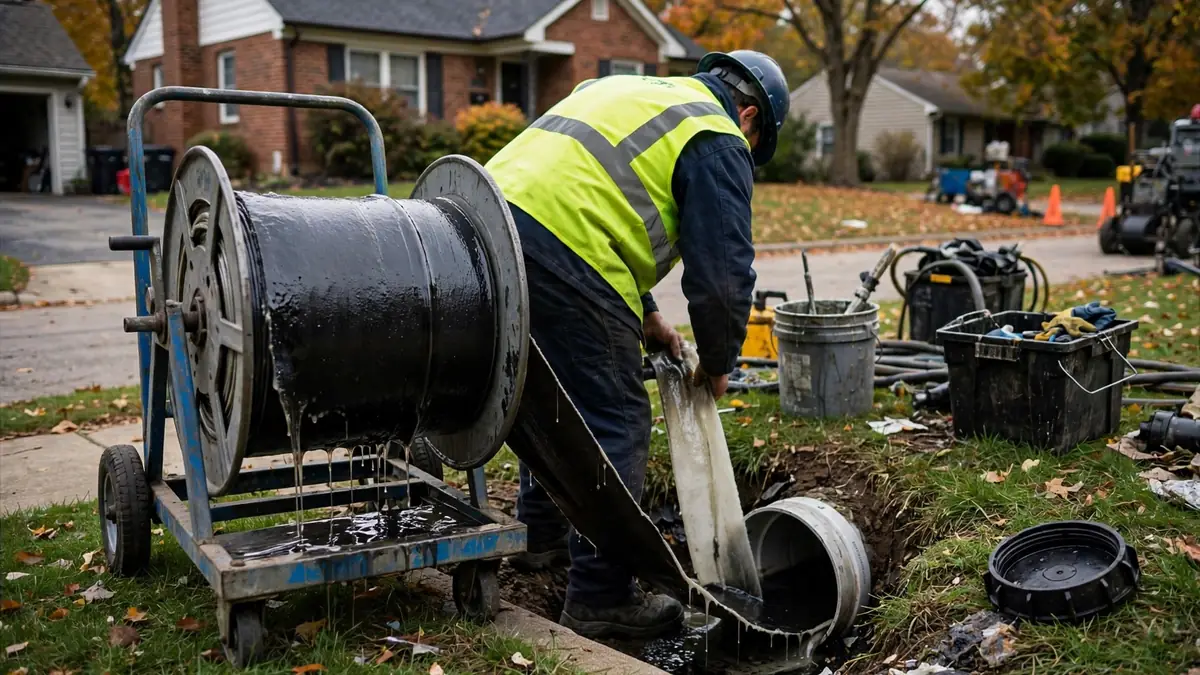
Trenchless sewer repair covers a family of methods, but on house laterals two do almost all the work. The first is cured-in-place pipe, usually shortened to CIPP or simply called lining. A flexible felt or fiberglass tube soaked in resin is pulled or turned inside out into the existing pipe, inflated against the old wall and left to harden. When it cures, it forms a seamless pipe within a pipe [2]. The old clay or cast iron stays in the ground as a host; it just no longer carries the flow on its own.
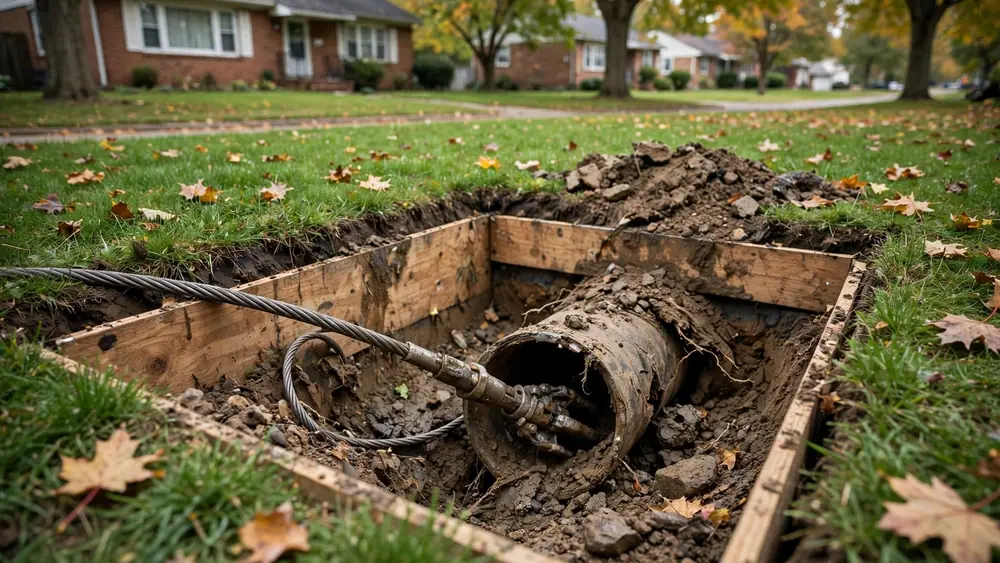
The second is pipe bursting. A cone-shaped bursting head is pulled through the old pipe by a cable or rods, splitting it and pushing the fragments into the surrounding soil, while a new length of high-density polyethylene follows directly behind it [3]. The result is a brand new pipe in the old route, often the same size or slightly larger. Bursting needs a pit at each end, one to launch the new pipe and one to receive the head, but nothing in between.
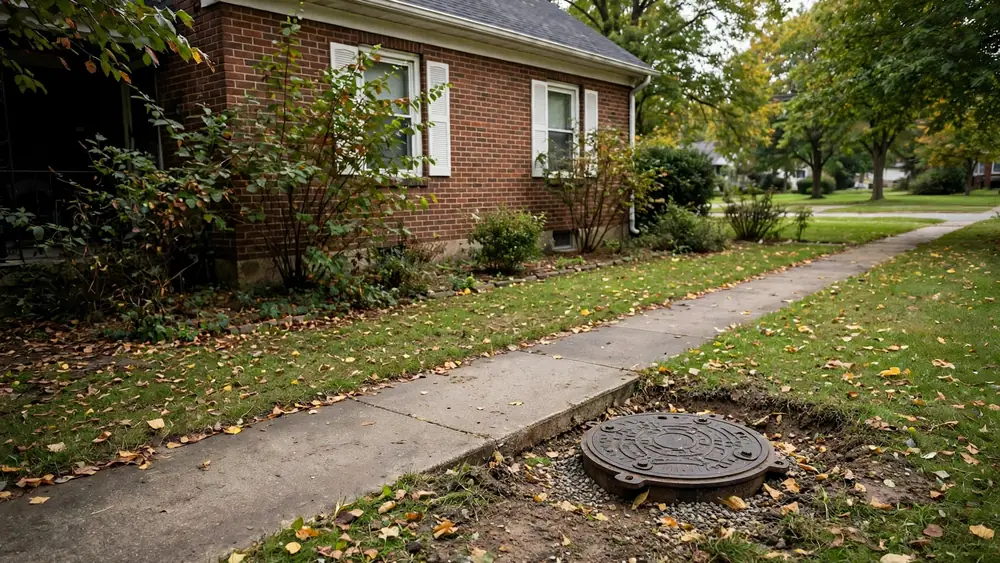
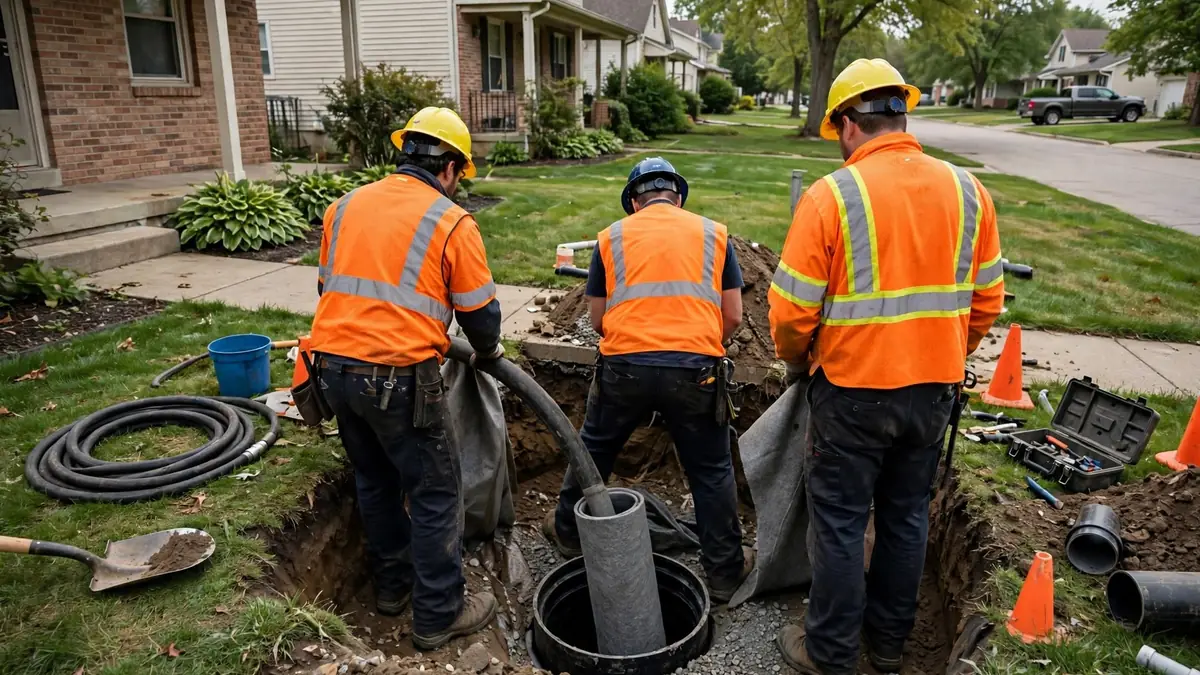
Both methods replace the trench that used to run from the foundation to the street. That matters on Indianapolis lots where the lateral passes under a front walk, porch steps, a mature tree lawn tree or a driveway. Instead of breaking all of that, the crew digs one small pit near the house, uses an existing cleanout, or works from the basement, and only digs at the street end if the connection itself needs attention. For the lining method in detail, see cured-in-place pipe lining; for bursting, see pipe bursting.
Good candidates
When a lateral is a fit for trenchless work
Roots at many joints
A clay line that keeps sprouting roots along its length is a classic case for a full-length liner that seals every joint at once.
Cracks with the pipe still round
Longitudinal cracks and small missing pieces can be bridged by a liner as long as the pipe has not caved in.
Something valuable on top
A front porch, an old brick walk, a large tree or a newly poured driveway over the route makes avoiding excavation attractive.
Deep lines
Where the lateral runs eight or ten feet down, a long open trench needs shoring; small pits are simpler and safer.
Old pipe in a decent path
Pipe bursting needs the old line to have a reasonable route without long sags, since the new pipe follows it.
Undersized or deformed pipe
Bursting can upsize a narrow line or replace flattening fiber pipe that is too far gone to line.
Why laterals fail
The damage trenchless methods are built to fix
Most of the laterals that end up lined or burst in Indianapolis are clay pipe from the first half of the twentieth century. The pipe body is hard and durable, but it was laid in short lengths, and every joint is a seam that was originally sealed with mortar, tar or a compression gasket. Decades of soil movement, freeze and thaw cycles and root pressure open those seams. Water and nutrients leak out, roots move in, and the bore slowly fills.
Fiber pipe from the post-war decades fails differently. It was light and easy to lay, but it absorbs water and gradually loses its round shape under the weight of the soil above, sometimes to the point of collapse [6]. Cast iron, used under basement floors and occasionally out to the street, corrodes from the inside and can split along the bottom. Each failure mode affects whether lining, bursting or digging is the right answer.
There is also the matter of what the pipe was laid on. Old trenches were often backfilled with whatever came out of them. Where that fill settled unevenly, sections dipped and created bellies. A liner follows the shape of the old pipe, belly included, so sags are one of the main reasons a trenchless repair is ruled out for part of a line.
Diagnosis first
How a contractor decides if trenchless will work
- 1
Clean the line fully
Roots, grease and scale are cut or jetted out so the camera can see every inch of the wall and the liner can bond.
- 2
Record a full camera run
A sewer camera inspection from cleanout to main shows the length, diameter, bends and every defect.
- 3
Check for sags and collapses
Standing water over a long stretch or a collapse the camera cannot pass usually rules lining out for that section.
- 4
Measure transitions
Changes from cast iron to clay, or from four-inch to six-inch pipe, affect liner sizing and where pits go.
- 5
Locate the connection
The video shows whether the tap into the main is sound or needs an excavated repair at the street.
- 6
Map what is on top
Trees, walks, steps and utilities marked through Indiana 811 decide where any pits can safely go [4].
Matching method to defect
Trenchless options by what the camera shows
| Condition | Lining (CIPP) | Pipe bursting | Excavation |
|---|---|---|---|
| Roots at joints, pipe round | Strong fit | Works | Only if other defects |
| Cracks, small holes | Strong fit | Works | Spot repair possible |
| Oval or deformed fiber pipe | Often unsuitable | Strong fit | Works |
| Fully collapsed section | No | Sometimes, if a cable can pass | Usually needed |
| Long belly holding water | No; liner copies the sag | No; new pipe follows the path | Needed to correct grade |
| Damaged tap at the main | Not on its own | Not on its own | Usually needed at the street |
| Pipe too small for current use | Reduces size slightly | Can upsize | Works |
The job
What a trenchless lateral repair looks like, step by step
- 1
Permit and dig-safe request
The contractor applies to Citizens Energy Group for the lateral permit and calls in an Indiana 811 locate before digging any pit [1][4].
- 2
Set up access
For lining, access is often an existing cleanout or a small pit by the foundation. For bursting, a launch pit and a receiving pit.
- 3
Bypass the flow
You will be asked not to use water for a period. The crew may plug the line or route flow around the work.
- 4
Prepare the host pipe
The line is cleaned again and re-filmed just before installation, because roots and debris left behind weaken the result.
- 5
Install the new pipe
A wet-out liner is inverted or pulled in and cured with hot water, steam or light; or the bursting head pulls new HDPE through.
- 6
Reconnect and reopen
Ends are trimmed, cleanouts and connections are restored, and any branch lines are reinstated from the inside.
- 7
Film, inspect and backfill
A final camera run shows the new pipe. Citizens inspects where required before the pits are filled and the surface restored [1].
Liner and pipe types
Materials used in trenchless lateral work
| Material | Method | Chosen for |
|---|---|---|
| Felt tube with epoxy resin | CIPP inversion or pull-in | Most residential laterals; bonds well to clay and cast iron |
| Fiberglass tube with light-cured resin | CIPP with UV curing | Faster cures; thinner walls where diameter matters |
| Short sectional liner (patch) | Packer-placed CIPP | A single cracked joint or short defect |
| High-density polyethylene (HDPE) | Pipe bursting | Fused, jointless replacement pipe; flexible and root-resistant |
| Connection or lateral-main liner | Specialty CIPP | Sealing the joint where the lateral meets the main |
DIY or pro
What homeowners can and can't do on a trenchless job
- You can find and expose the cleanout cap and clear the basement area around it.
- You can share any earlier inspection video so the contractor sees the line's history.
- You can ask for the before and after camera runs in writing, with footage and depth.
- You should not rent equipment to line or burst a sewer; Citizens requires a licensed contractor for any lateral work [1].
- You should not use chemical root killers right before lining; residue can interfere with resin bonding unless the line is thoroughly cleaned.
- You can check the contractor's plumbing license status with the state Professional Licensing Agency [5].
- You can ask how the liner's cure is checked and what the new inside diameter will be.
- You can plan where the crew will park and set up, since equipment trailers need space on narrow city streets.
On the day
Living in the house while the lateral is relined
Most trenchless lateral jobs on a single-family house are done in a day, sometimes two if pits are needed at both ends or the curing method is slow. During the work the sewer is out of service, so plan for no flushing, showers, laundry or dishwashing until the crew says the line is open. Some households plan to be out for the day; others use a neighbor's bathroom.
Expect equipment in front of the house: a truck or trailer with the liner wet-out gear or the bursting machine, a boiler or steam unit for some cures, hoses into the basement or the pit, and a camera rig. The crew may need access to the basement cleanout for much of the day. If the lateral serves a double or a small apartment building, everyone on that line needs to know the timing.
Afterwards, the pits are backfilled once any required inspection is done, and the surface restored. Unlike a full trench, that usually means a couple of patches of soil rather than a strip across the whole lawn. Grass seed or sod is typically the homeowner's to water, so ask what restoration is included.
Local specifics
Trenchless repair under Indianapolis rules and streets
Citizens Energy Group's lateral rules are clear that lining is regulated work: its guidance lists repairs, cleanouts, replacements and lining as requiring a permit, while routine cleaning and root removal do not [1]. The contractor applies online, single-family reviews generally take a few business days, and Citizens inspects the work before the excavation is closed [1]. A contractor who suggests skipping the permit because the job is trenchless is giving you bad advice.
Indianapolis streets add their own wrinkles. In older neighborhoods the main often sits under the middle of the street or even across it, so the connection can be a long way from the curb. If the tap needs work, that excavation is in the public right-of-way and typically needs its own coordination. Narrow streets in places like Fountain Square or Irvington also limit where a liner truck can park.
Soil matters too. Central Indiana's glacial clays and tills hold water and expand when wet, which is part of why old joints shift. A sealed liner or fused HDPE pipe has no joints for that movement to open, which is a large part of the appeal on clay laterals under big street trees.
Afterwards
Keeping a lined or burst lateral in good shape
- Keep grease, wipes and paper towels out of the line; a liner is smooth but not immune to buildup.
- Ask for the final inspection video and keep it with the house records.
- If the liner stops short of the main, ask what condition the remaining few feet are in.
- Do not use a heavy root saw on a liner later; ask any future contractor to use cleaning heads suitable for lined pipe.
- Re-film the line after a few years, or sooner if drains slow down.
- Keep new trees and shrubs off the lateral's route where you can.
Repair or replace
Trenchless, open trench or a spot repair?
A single defect in an otherwise healthy line often calls for a spot fix: either a short sectional liner placed from inside or a small excavation at the marked spot. Lining or bursting the whole length makes sense when defects are spread along the line, when roots are entering at many joints, or when the pipe material itself is near the end of its life.
Open-trench sewer line replacement remains the right answer for bellies, for pipe that is too collapsed to line and too badly routed to burst, and for lines where the depth is shallow and nothing of value sits on top. Many real jobs are hybrids: a dug repair at a sag or at the main connection, and lining for the rest.
The honest test is the camera. If the contractor cannot show you on video why a method fits your pipe, ask more questions. The trenchless vs excavation guide walks through the trade-offs in more detail.
Before you agree
Questions to put to a trenchless contractor
- Which method, and why for my pipe?The answer should point to specific footage on your video: round pipe with joint roots for lining, deformed pipe for bursting, a sag for excavation.
- Where will the liner or new pipe start and stop?Ask whether it runs from the cleanout all the way to the main, or stops short, and what happens to the unlined part.
- How are branch connections handled?If a second drain joins the lateral underground, it has to be reopened from inside after lining. Ask how that is located and cut.
- What resin and cure method is used?Ambient, hot water, steam and light-cured systems each have different set times and handling needs.
- Who handles the permit and inspection?The contractor should apply to Citizens Energy Group and schedule the inspection, and tell you when each happens.
- What does restoration include?Ask how pits are backfilled and whether grass, pavers or concrete over a pit are put back or left to you.
- Will I get the before and after video?Both recordings are your proof of what was done and your baseline for the future.
Old repairs
When a lateral already has a patch in it
Older lines sometimes carry a previous repair: a short PVC section dug in years ago, or a sectional liner. The camera shows these as a change in wall color or texture. A new full-length liner or a bursting head has to deal with that transition, so mention any repair you know about when you call.
FAQ
Questions about no-dig sewer repair in Indianapolis
Is trenchless sewer repair allowed in Indianapolis?
Yes. Citizens Energy Group treats lining as permitted lateral work, the same as a dug repair. A licensed contractor applies for the permit, and Citizens inspects the work before any excavation is backfilled.
How long does a sewer liner last?
Manufacturers typically design cured-in-place liners for a service life measured in decades. Real life depends on installation quality, the resin system and how the line is used, so ask the contractor what the product is rated for.
Can every sewer line be lined?
No. The old pipe has to be clean and mostly round. Long sags, fully collapsed sections and some badly offset joints rule out lining for that stretch, and excavation or bursting is used instead.
Does lining make my pipe smaller?
Slightly. The liner wall takes up a few millimeters on each side. On a typical four- or six-inch house lateral the smoother wall usually makes up for the small loss in diameter.
Is pipe bursting the same as lining?
No. Lining builds a new pipe inside the old one. Bursting destroys the old pipe and pulls a new polyethylene pipe into its place, which can also increase the diameter.
Will a liner stop tree roots for good?
A properly installed liner has no joints, so roots have no seam to enter through. Roots can still press against the outside or enter at an unlined section or the ends, which is why the final video matters.
Do I still need digging for a trenchless repair?
Usually a little. Lining may need one small pit or none if there is a good cleanout. Bursting needs a launch pit and a receiving pit. The street connection may need its own excavation if it is damaged.
Can I use my plumbing during the job?
Not while the line is being prepared, lined or cured. Plan for several hours without water use, and wait for the crew to tell you the line is open again.