Key facts: Sewer Line Replacement
- A replacement lays new pipe for the whole lateral, usually PVC or fused polyethylene, at a proper slope to the main.
- Citizens Energy Group requires a permit for lateral replacement and inspects the open trench before backfill [1].
- Only a licensed contractor or plumber may replace a lateral connected to the Indianapolis system [1].
- An Indiana 811 locate request comes before any digging so buried utilities are marked [2].
How it works
What replacing a house sewer involves
A sewer line replacement removes the old lateral, or abandons it in place, and installs a new pipe from the house's foundation to the connection at the public main. On a typical Indianapolis city lot that means a run of several dozen feet under the front yard, sometimes under the sidewalk and tree lawn, and in many older neighborhoods out into the street where the main runs.
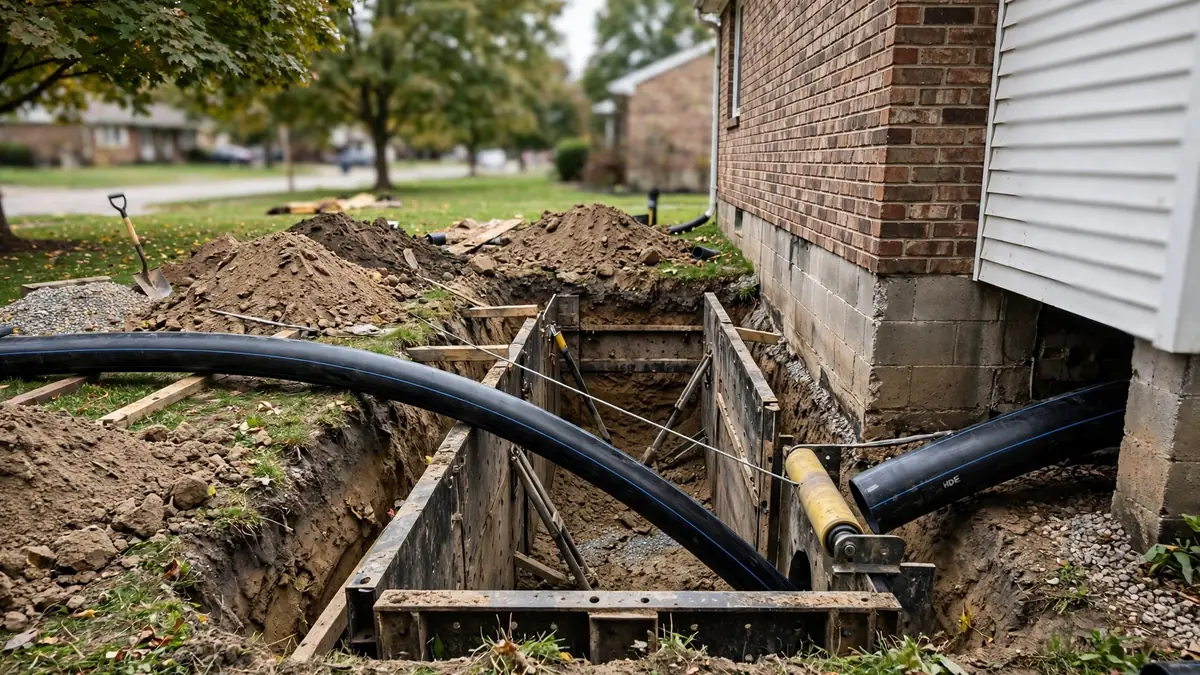
There are two broad ways to do it. Open-trench replacement digs along the pipe's route, lifts out the old pipe, lays new pipe on a prepared bed at a consistent slope and backfills. Trenchless replacement by pipe bursting pulls a new polyethylene pipe through the old one from a pit at each end, splitting the old pipe as it goes [6]. Both produce a new pipe; they differ in how much ground is opened.
In both cases the new pipe ties into the house drain, usually at or just outside the foundation, and into the public sewer at the existing tap or a new one. Citizens Energy Group, which runs the Indianapolis system, requires a permit for this work and inspects the connection before the trench is backfilled [1]. Many replacements also add an outside two-way cleanout near the house so the new line can be reached easily later.
Warning signs
Signs a lateral has reached the end of its life
Collapse on camera
A section where the camera cannot pass, or where the pipe wall has fallen in, cannot be lined.
Flattened fiber pipe
Bituminized fiber pipe that has gone oval or blistered along its length is usually replaced rather than patched [5].
Several bellies
Standing water in more than one stretch means the line has lost its grade and solids settle in the low spots.
Breaks in many places
When cracks, offsets and missing pieces appear every few feet, spot repairs just chase the next failure.
Soil in the pipe
Dirt and gravel on the camera, or a sinkhole over the line, shows soil washing in through breaks.
Backups that clearing won't fix
If the line clogs again within weeks of cleaning, the pipe is likely too damaged to hold its shape.
Why replacement
Why some Indianapolis laterals can only be replaced
Pipe material sets the clock. Vitrified clay, used for house sewers from the 1800s well into the 1960s, resists chemical attack but was made in short lengths [4]. Its many joints are its weakness, and after decades of roots and soil movement some lines have joints that are displaced by inches, not fractions of an inch. Once the joints are that far out of line, lining tends to wrinkle at each step and roots return at the gaps.
Bituminized fiber pipe, often called Orangeburg after a manufacturer in New York, was popular in the building booms after the Second World War [5]. It is essentially layers of wood pulp fiber bonded with coal-tar pitch. Over time it softens and deforms under load. Many central Indiana houses from the 1940s through the early 1970s have it, at least in part of the lateral. When it has turned oval, the only reliable fixes are bursting it or digging it out.
Grade is the other reason. A sewer needs a steady fall toward the main. Old trenches were often backfilled with loose soil that settled unevenly, leaving bellies where water and waste sit. No liner corrects grade, because a liner takes the shape of the pipe it is in. To fix a sag, the pipe has to be dug up and relaid at the right slope.
Testing
How a contractor confirms a line needs replacing
- 1
Clear and film the full length
Cleaning first, then a camera run from the cleanout to the main, with footage noted at every defect.
- 2
Identify the pipe materials
Many laterals change from cast iron to clay or fiber partway. Each part is judged on its own condition.
- 3
Measure sags
The length and depth of standing water on video show how far the line has lost its grade.
- 4
Locate depth along the route
Readings at several points show whether the line is shallow enough for an easy trench or deep enough to need shoring.
- 5
Check the tap
If the connection at the main is broken or offset, it is replaced too, often with an excavation in the street.
- 6
Compare methods
With depth, route and condition known, the contractor explains whether bursting, open trench or a mix fits best.
Diagnosis
Replace, line or spot repair: how findings point
| Finding | Leans toward | Reason |
|---|---|---|
| One crack, rest of the line sound | Spot repair | Replacing good pipe adds disruption without benefit |
| Roots at most joints, pipe round | Lining or replacement | Both seal the joints; access and depth decide |
| Deformed fiber pipe along its length | Bursting or replacement | A liner needs a round host pipe |
| Belly longer than a few feet | Excavate that section | Only digging restores slope |
| Multiple collapses | Open-trench replacement | Bursting cable or liner may not pass |
| Broken tap at the main | Dig at the connection | The tap must meet Citizens standards |
The job
How an open-trench sewer replacement is carried out
- 1
Permit and utility locates
The contractor files the Citizens Energy Group permit and calls Indiana 811 so gas, electric, water and cable lines are marked [1][2].
- 2
Protect what can be protected
Sod is cut and rolled where possible, walks are saw-cut at joints, and tree roots near the trench are handled with care.
- 3
Excavate and shore
The trench is dug along the route. Deeper trenches are sloped or shored for safety before anyone enters.
- 4
Remove or abandon the old pipe
Old clay or fiber pipe comes out of the trench, or is left and plugged where the new pipe takes a different path.
- 5
Bed and lay the new pipe
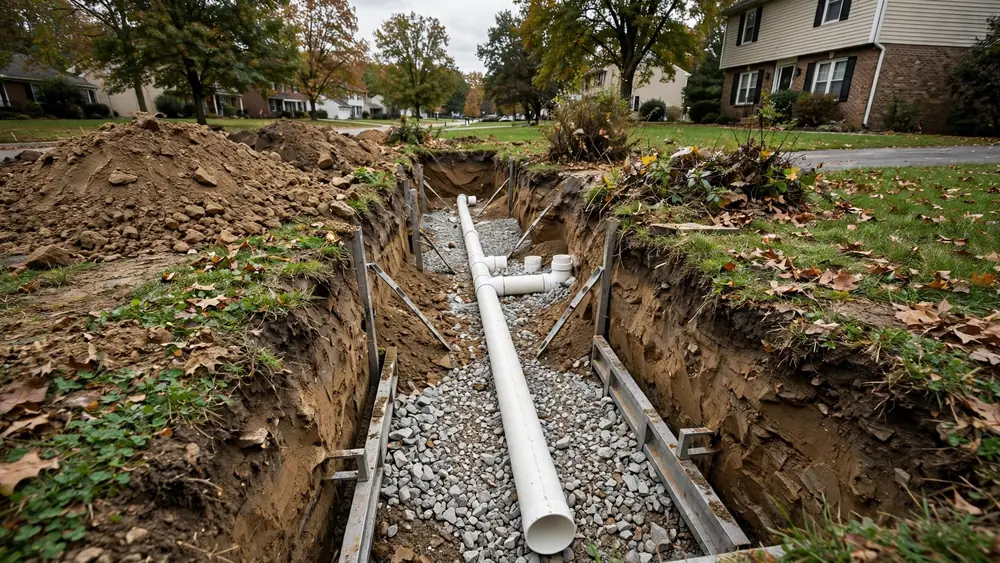
Stone bedding is placed and graded, then new pipe is laid with consistent fall and joined with gasketed or solvent-welded fittings.
- 6
Connect and add a cleanout
The new line joins the house drain and the main connection; a two-way cleanout is often added near the foundation.
- 7
Inspection, then backfill
Citizens inspects the open work. Once it passes, the trench is backfilled in layers and the surface restored [1].
Pipe choices
New pipe materials for an Indianapolis lateral
| Material | Joints | Typical use |
|---|---|---|
| PVC sewer pipe (SDR 35 or Schedule 40) | Gasketed bell or solvent-welded | Most open-trench laterals |
| HDPE polyethylene | Heat-fused, jointless | Pipe bursting and deep or long runs |
| Cast iron (no-hub or service weight) | Couplings or lead and oakum on old work | Inside the house and under floors |
| Ductile iron | Mechanical joints | Where extra strength is needed under heavy loads |
The contractor chooses pipe that meets Citizens Energy Group's sanitary standards and the Indiana plumbing code.
DIY vs pro
Where homeowners fit into a replacement project
- Citizens allows only licensed contractors or plumbers to work on laterals, so the digging and pipe work are not a homeowner job [1].
- You can move cars, planters, fence panels and lawn furniture out of the route before the crew arrives.
- You can mark private items the utility locate will not show, such as invisible dog fences, sprinkler lines and landscape lighting.
- You can ask the contractor to keep sod and pavers aside for reuse.
- You can photograph the yard, walk and driveway before work begins.
- You can ask to see the open trench and the new pipe before backfill, and photograph it.
- You can confirm the contractor's plumbing license status with the state [3].
- You should never enter an open trench yourself; deep, unshored trenches can collapse without warning.
The visit
What replacement day feels like at home
A straightforward replacement on a single-family lot is often finished in one to three days, depending on length, depth, what is in the way and how quickly the inspection is scheduled. The sewer is out of service while the old pipe is disconnected, which may be most of a day or more. Plan for no water use during that window.
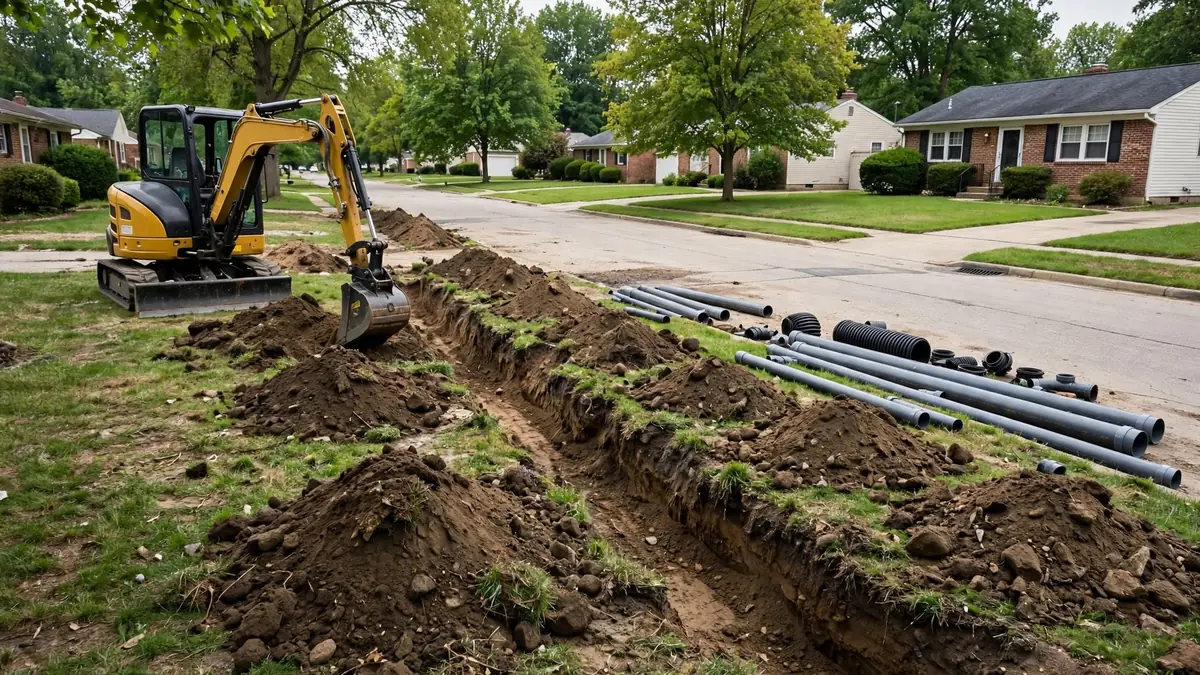
Expect an excavator or mini-excavator, a dump truck or trailer, stone for bedding, and piles of soil on tarps beside the trench. If the route crosses the public sidewalk or the street, there may be barricades and, for street work, additional coordination. Neighbors appreciate a heads-up, especially if parking will be blocked.
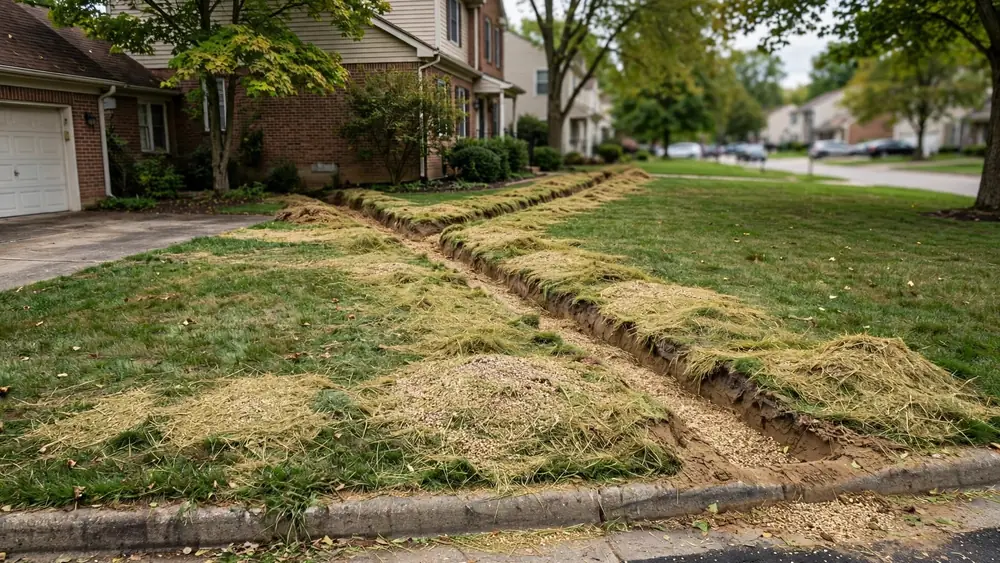
Once Citizens has inspected and the trench is backfilled, the yard will look raw for a while. Backfill settles, so a slight mound is normal at first. Ask the contractor how they compact the backfill and whether they come back to top up settled areas.
Local specifics
Replacing a lateral within the Citizens Energy Group system
In Indianapolis, the lateral belongs to the property owner from the home to the main, and Citizens Energy Group sets the standards for how it connects [1]. The contractor applies online for a permit, which the utility says generally takes a few business days to review for single-family homes and longer for multi-family or commercial buildings. When the pipe is laid and connected, the contractor calls for an inspection, typically the same or next business day, and leaves the trench open until it passes [1].
Citizens also notes that it does not recommend particular contractors and suggests getting more than one quote [1]. For work in Indianapolis the contractor must be registered with the City, with insurance and a bond in place [1]. Those requirements are worth asking about directly on the call.
Many older Indianapolis neighborhoods have the main under the street rather than in an alley or backyard easement, so the connection end of the replacement can land in the roadway. Street cuts bring traffic control and pavement restoration that a yard-only job does not, and they are one reason two replacements on the same street can look very different in scope.
Choosing the method
Open trench or bursting for a full replacement
Pipe bursting is often the first option considered when the route is reasonably straight, the old pipe can still pass a cable and there is something above it worth keeping, such as a large tree, steps or a newer driveway. It leaves two pits instead of a trench, and the new polyethylene pipe has fused joints with no seams for roots to find [6].
Open trench is usually better when the line has significant sags that need correcting, when the route is unknown or badly bent, when the old pipe has collapsed in several places, or when the line is shallow and under plain lawn. It also lets everyone see the pipe bed and connections directly.
Many jobs combine the two: bursting most of the run and opening a pit at a belly or at the street tap. The trenchless vs excavation guide compares the approaches in more detail.
Prevention
Making a new sewer line last
- Ask for an outside cleanout so future cleaning and camera work do not have to go through the basement.
- Keep the final camera video and the locate marks or a sketch of the route.
- Do not plant trees directly over the new line; even jointless pipe can be crushed by large roots near the surface.
- Keep grease and wipes out of the drains.
- Watch for settlement over the trench in the first few months and top it up.
- If the house had storm-related backups, ask about adding a backwater valve while the line is open.
Repair or replace
Deciding between a partial fix and a full new line
Replacing the whole lateral is the biggest sewer job a homeowner usually faces, so it is fair to ask whether a partial fix would do. If the camera shows one bad section in otherwise sound pipe, a trenchless repair or a spot excavation can make sense. If defects are spread along the line, the material is fiber pipe, or there are several bellies, a partial repair often moves the failure a few feet down the line.
Think about the age and material of what would remain. Fixing one joint in a ninety-year-old clay line leaves dozens of other joints of the same age. Replacing the line once, with a cleanout and a correct slope, is often what ends repeated visits. Your contractor's video and explanation should make the reasoning clear either way.
Shared lines and doubles
Replacing a lateral that serves more than one home
Indianapolis has a large stock of doubles, small multi-unit buildings and older houses that were converted to apartments. Some of them share a single lateral, and occasionally two neighboring houses were connected to the same pipe decades ago before anyone recorded it. The camera usually reveals this as a second line joining partway down the run, or as a wye fitting that leads somewhere other than your own foundation.
A shared line raises practical questions before a replacement starts. Who owns which part? Will the neighbor's plumbing be out of service during the work? Does the new installation need to separate the two houses so each has its own connection? Citizens Energy Group's permit review for multi-family and commercial properties also takes longer than for single-family homes [1], which affects scheduling.
If you suspect a shared lateral, raise it on the first call. The contractor can confirm it on camera, and you can talk with the neighbor or building owner before anything is dug. Settling responsibility and timing in advance avoids a dispute in the middle of a trench.
Restoration
What the yard and walk look like after the trench is closed
- LawnTopsoil is replaced over the backfill and seeded or sodded; seed needs regular watering for several weeks to take.
- SettlementEven well-compacted backfill can sink a little after the first heavy rains, so a slight crown over the trench is normal at first.
- Sidewalks and walksCut sections of concrete are usually replaced to the nearest joint so the patch lines up with the existing walk.
- Street cutsPavement over a street connection is restored to the standards that apply to the right-of-way, which may happen in stages.
- TreesRoots cut near a large tree can stress it; ask how the crew will limit cutting and whether an arborist should look at it.
- LandscapingShrubs and perennials in the route can often be lifted and replanted if you move them before the crew arrives.
Related problems
Other sewer problems tied to a failing lateral
Replacement is usually the end of a longer story: repeat root intrusion removal visits, a basement backup or two, or wet spots in the yard. If sewage reached the basement, the cleanup is a separate job covered on sewer backup cleanup. For early warning signs, see signs of a broken sewer line.
FAQ
Sewer line replacement questions from Indianapolis homeowners
How long does it take to replace a sewer line in Indianapolis?
Many single-family replacements take one to three days of work, plus a few business days beforehand for the Citizens permit review. Street excavations, deep lines and inspection scheduling can extend that.
Who replaces the sewer line from my house to the street?
You hire a licensed contractor, because the lateral from the home to the main is the owner's responsibility under Citizens Energy Group's rules. Citizens maintains the public main and inspects the connection.
Does a new sewer line need an inspection?
Yes. After the new pipe is installed and connected, the contractor calls Citizens for an inspection, and the trench stays open until it passes. Then it can be backfilled.
What pipe is used for a new sewer lateral?
Open-trench replacements commonly use PVC sewer pipe; pipe bursting uses heat-fused polyethylene. The contractor picks pipe that meets the utility's sanitary standards and the plumbing code.
Can a sewer line be replaced without digging up the whole yard?
Often yes, with pipe bursting through a pit at each end. Sags, collapses and a damaged street connection may still need some excavation.
Will my driveway or sidewalk be torn up?
Only if the route passes under them and the method is open trench. Bursting or lining can often pass beneath without breaking the surface. Ask the contractor to show the planned pit locations.
What happens to the old sewer pipe?
In open-trench work it is usually removed. With pipe bursting it is split and pushed into the surrounding soil. Sections on a different route may be plugged and left in place.
Should I add a cleanout when the sewer is replaced?
It is commonly recommended. An outside cleanout near the foundation gives easy access for cleaning and camera work, so future visits do not have to start in the basement.