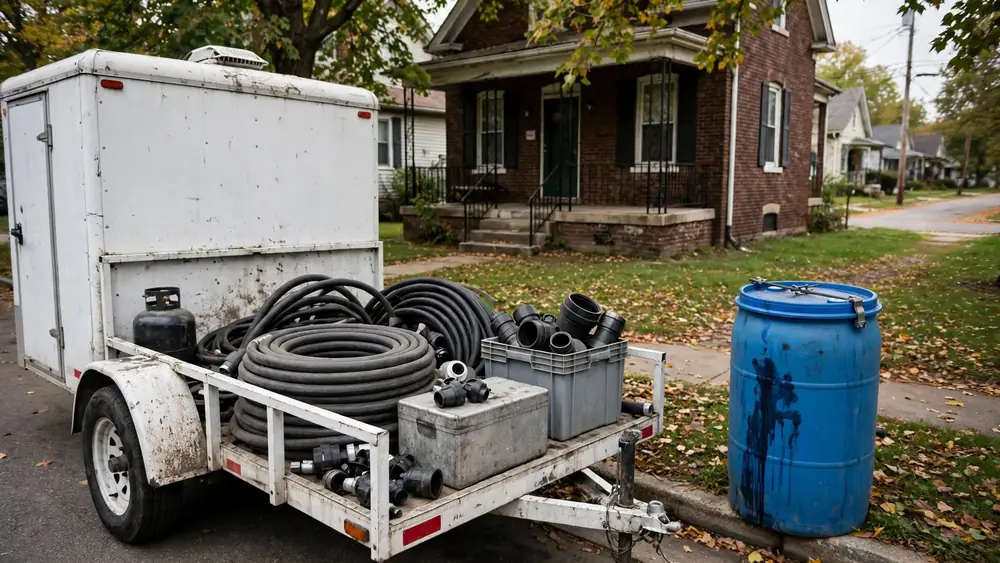
Key facts: CIPP Pipe Lining
- Cured-in-place pipe is a resin-impregnated tube installed inside an existing pipe and cured to form a new, jointless pipe [2].
- Citizens Energy Group requires a permit for lining a lateral in Indianapolis, the same as for repairs and replacements [1].
- Lining needs a clean, mostly round host pipe; collapses and sags generally have to be excavated instead.
- Branch connections inside the lined pipe are reopened from inside with a remote cutter after curing.
How it works
Building a new pipe inside the old lateral
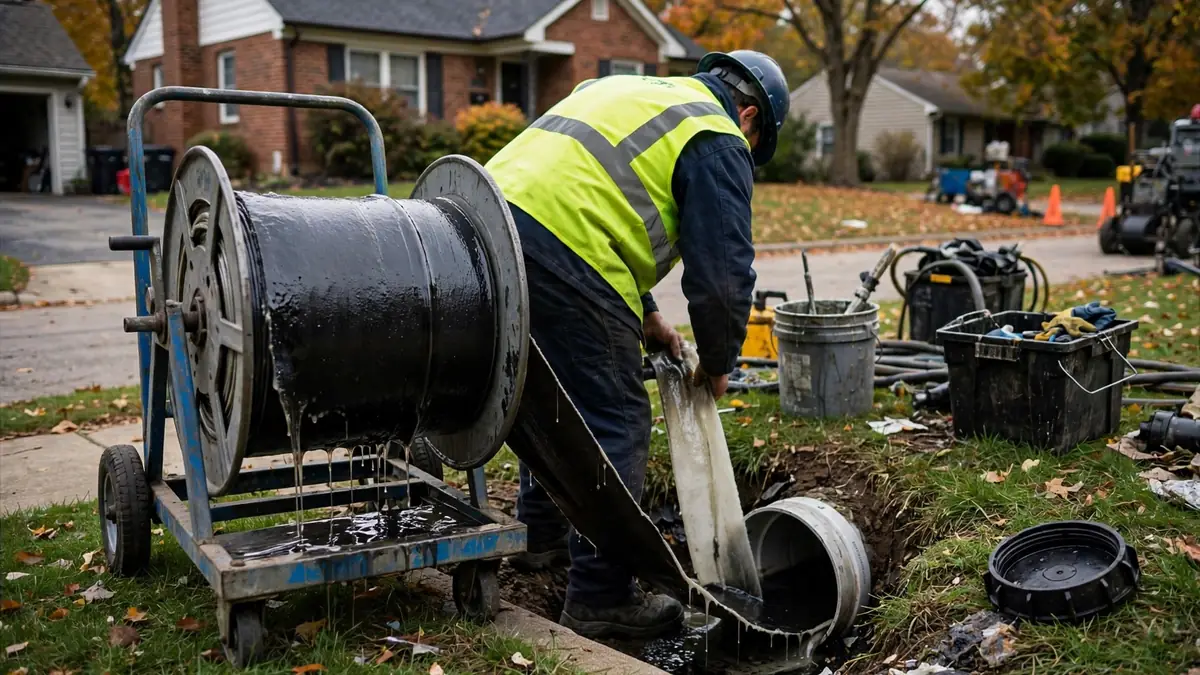
Cured-in-place pipe, or CIPP, is a flexible tube made of felt, fiberglass or a similar fabric, sized to the inside of the old pipe. At the job site or in the contractor's shop, the tube is saturated with a liquid resin, usually an epoxy for residential laterals. It goes into the old pipe either by inversion, where air or water pressure turns the tube inside out as it travels down the pipe, or by pull-in, where it is drawn through and then inflated with a bladder [2].
Once in place, the tube is pressed firmly against the old pipe wall and held there while the resin hardens. Curing can happen at ambient temperature over several hours, or faster with hot water, steam or, for some fiberglass systems, ultraviolet light. When it has cured, the bladder is removed and what remains is a rigid, seamless pipe that fits tightly inside the old one.
The old pipe does not have to be structurally perfect, but it does have to act as a form. It needs to be clean and close to round so the liner can press evenly against it. Cracks, missing pieces and open joints are bridged by the liner; collapses, long sags and severe offsets are not something a liner can fix.
Good candidates
When lining is a strong option for a lateral
Root-prone clay joints
Sealing every joint at once is the main reason Indianapolis homeowners choose lining for clay laterals [3].
Cracked but round pipe
Longitudinal cracks and small holes are bridged by the new wall.
Pipe under a porch or driveway
Lining from the cleanout avoids breaking concrete or steps over the route.
Cast iron under the basement floor
Corroded cast iron building drains can be descaled and lined without breaking the floor.
Single bad joint
A short sectional liner can seal one defect without lining the whole run.
Deep laterals
Where the line is too deep for easy digging, lining avoids a large shored trench.
Why lining
Why clay laterals and liners go together
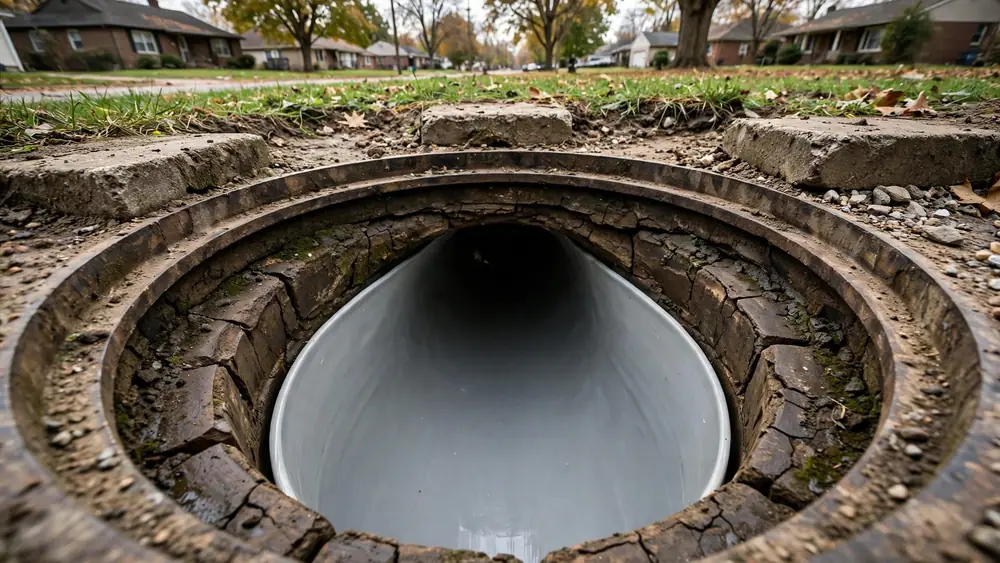
Clay pipe has one big weakness: joints. Most Indianapolis laterals installed before the 1960s used two- to three-foot lengths of vitrified clay, so a fifty-foot lateral can have twenty or more joints [3]. The clay between them is hard and long-lasting, which is exactly why lining works so well here. The pipe body is a solid form; the joints are what need sealing.
When roots return year after year to the same lateral, cutting them treats the symptom. A full-length liner removes the cause by putting a continuous wall across every joint. Roots outside the pipe have no seam to follow in. The root intrusion removal visit that clears the line is usually the first step of a lining job rather than an alternative to it.
Lining also keeps what is above the pipe intact. Many of the city's older front yards have mature trees in the tree lawn, steps leading up to the porch, and walks laid decades ago. Lining through an existing cleanout or a single small pit leaves all of that undisturbed.
Can it be lined?
How a contractor confirms a lateral can be lined
- 1
Clean to bare wall
Hydro jetting and root cutting remove everything from the wall; the liner bonds poorly to debris.
- 2
Film every foot
The camera checks for collapses, sags and offsets too large for a liner to span.
- 3
Measure diameter and length
Liner tubes are made to size, so transitions from four to six inch pipe are noted exactly.
- 4
Find branch connections
Any second line joining the lateral underground has to be located so it can be reopened later.
- 5
Check the ends
The contractor decides where the liner will start and stop: at the cleanout, the foundation, or the main.
- 6
Confirm access
A cleanout big enough for the liner, or a spot for a small pit, is needed to get it in.
Fit by defect
Which lateral defects a liner can and can't handle
| Defect | Can a liner fix it? | Notes |
|---|---|---|
| Roots at joints | Yes, after cleaning | The main reason to line clay pipe |
| Hairline and longitudinal cracks | Yes | Liner bridges them |
| Missing pieces of wall | Usually, if small | Large holes may need a spot repair first |
| Small offset joints | Usually | Wrinkles may form at larger steps |
| Large offset or separated joint | Often not | May need excavation at that spot |
| Belly holding water | No | Liner copies the sag |
| Collapsed section | No | Excavate or burst |
| Oval fiber pipe | Rarely | Bursting is usually the better trenchless option |
The installation
A lateral lining job from start to finish
- 1
Permit
The contractor applies to Citizens Energy Group for the lining permit [1].
- 2
Final cleaning and video
The line is cleaned once more right before lining and filmed to confirm it is ready.
- 3
Measure and wet out
The tube is cut to length and saturated with mixed resin, often under vacuum so no dry spots remain.
- 4
Install the tube
The liner is inverted with air or water pressure, or pulled in and inflated with a bladder.
- 5
Cure
The resin hardens at ambient temperature or with hot water, steam or light, depending on the system.
- 6
Remove the bladder and trim ends
The ends are cut cleanly at the cleanout and at the downstream end.
- 7
Reinstate branches and film
Any side connections are reopened with a remote cutter and the finished liner is filmed for the record and inspection [1].
Systems
Lining systems used on residential sewers
| System | How it's installed | Typical use |
|---|---|---|
| Full-length inversion liner | Turned inside out down the pipe with air or water | Whole laterals from cleanout to main |
| Pull-in-place liner | Pulled through, then inflated with a bladder | Lines with bends or tricky access |
| Sectional (point) liner | Carried on a packer to one spot and inflated | Single cracked joint or short defect |
| UV-cured fiberglass liner | Pulled in, cured with a light train | Faster cures; thinner walls |
| Lateral-to-main connection liner | Shaped liner set at the tap | Sealing where the lateral meets the main |
DIY vs pro
What homeowners should and shouldn't do around a lining job
- Lining is lateral work, and Citizens permits it only for licensed contractors [1].
- Clear the basement around the cleanout; the crew will need room for hoses and the inversion drum.
- Tell everyone in the house not to run water, flush or use appliances until the crew says so.
- Ventilate the basement if the crew works from inside; resins can have a noticeable odor while curing.
- Do not pour chemical root killers or drain openers down the line in the weeks before lining.
- Ask what resin is being used and how the cure will be confirmed.
- Ask for the before and after videos and keep them with the house records.
- Verify the contractor's plumbing license with the state [4].
The visit
Lining day inside the house
Most residential lining jobs fit into a day. Morning is often cleaning and a final video, midday the wet-out and installation, and afternoon the cure, trimming and reinstatement. Faster-curing systems shorten that; slow ambient cures may mean the line stays out of service into the evening.
If the crew works from a basement cleanout, they will run hoses through a window or door and set up the inversion equipment near the cleanout. Expect some noise from air compressors or boilers outside and an odor from the resin indoors. Opening basement windows helps.
When it is done, the crew should show you the final video: a smooth, continuous wall from the start point to the end point, with any branch connections cleanly reopened. That video is also what Citizens and future contractors will want to see.
Local specifics
Lining laterals in the Citizens Energy Group system
Citizens Energy Group, which runs the Indianapolis sewer system, puts lining in the same category as repairs, cleanouts and replacements: it needs a permit, applied for online by the contractor [1]. Routine cleaning and root removal do not. The utility also requires lateral work to be done by licensed contractors and inspects completed work [1]. A contractor who suggests lining without a permit is cutting a corner that matters if you ever sell the house.
Many Indianapolis laterals connect to mains under the street, and the last few feet near the main can be the hardest to reach. Some liners stop at the curb or at the property line, leaving the connection unlined. Ask exactly where your liner will end, what condition the remaining pipe is in, and whether a connection liner or an excavated repair at the tap is recommended.
Houses with basements often have a cast iron building drain under the floor that joins the clay lateral at the foundation. That transition is a common weak point. Some contractors line from inside the house through the foundation to the main in one shot; others line the exterior clay only. Either can be fine; the point is to know which is planned.
Under the floor
Lining cast iron drains beneath a basement slab
Inside the house, the drain under the basement floor is often cast iron from when the house was built. Over decades, the inside corrodes into a rough, lumpy surface, and the bottom of the pipe can wear thin and crack where wastewater has run for a century. Breaking out a basement floor to replace it is disruptive, especially in a finished basement.
Descaling and lining is a common alternative. Specialized cutting heads grind the scale back to sound metal, the pipe is filmed, and then a liner is installed through the cleanout. Branches from floor drains, laundry and basement bathrooms are reinstated afterwards. The result is a smooth, sealed drain without breaking concrete, as long as the cast iron still has enough shape to hold the liner.
Afterwards
Caring for a lined sewer line
- Keep the final video; future buyers and contractors will ask for it.
- Tell any future drain contractor the line is lined so they avoid aggressive root saws.
- Keep grease, wipes and paper towels out of the drains.
- Have the line filmed again if drains ever slow down.
- Check where the liner ends; unlined pipe beyond it still ages normally.
- Keep the cleanout accessible and capped.
Choosing
Lining compared with bursting and digging
Lining is often the least disruptive way to deal with a round clay lateral that lets roots in at its joints. Pipe bursting is usually better for deformed fiber pipe or when a larger pipe is wanted. Open-trench sewer line replacement is needed for sags and collapses. Many projects mix them: a dug repair at a belly, lining for the rest.
If you are weighing the options, the parent page on trenchless sewer repair and the trenchless vs excavation guide set out the trade-offs.
Sectional liners
Point repairs for a single bad joint
Not every lateral needs lining end to end. When a camera shows one cracked joint or a short damaged stretch in an otherwise healthy pipe, a sectional liner can be the right size of fix. A short length of resin-soaked liner is wrapped around an inflatable packer, pushed to the exact spot using the camera footage, then inflated and held until it cures. The packer is deflated and pulled out, leaving a sleeve that seals the defect.
Sectional liners work best on straight runs with sound pipe on each side. If several spots along the line need them, a full-length liner is usually the more sensible approach, because the joints between the patches will keep aging.
Access points
Getting a liner into a lateral without a good cleanout
The easiest lining jobs start at an outside two-way cleanout near the foundation, where the liner can be fed straight down the lateral toward the street. Many older Indianapolis houses do not have one. Their only access is a cast iron cleanout inside the basement, sometimes behind a furnace or under a stairway, and some have no usable cleanout at all.
Contractors work around this in a few ways. Some line from the basement cleanout, running the inversion equipment indoors and pushing the liner out through the foundation. Others dig a small pit just outside the foundation, cut into the lateral and install an outside cleanout at the same time, which gives a clean starting point for the liner and permanent access afterwards. Installing a cleanout is itself permitted lateral work [1], so it can be folded into the same permit.
Ask on the call how the contractor plans to get the liner in. The answer affects how much of the basement is used, whether there is any digging, and whether you end up with a better cleanout than you started with.
Before you agree
Questions to ask about a proposed liner
- Where does it start and end?From the cleanout or foundation to the main, or only part of the way?
- What about the connection at the main?Is the tap included, and if not, what condition is it in on video?
- Which resin and cure?Epoxy, other resin types, ambient, hot water, steam or UV, and why for your line.
- How are wrinkles controlled?Offsets and bends can cause folds; ask how they will be minimized and judged.
- How are branches reopened?Ask what tool is used and how each connection is located.
- What will I receive?Before and after video, the length lined and the permit details.
Wrinkles and ends
Reading the final lining video
A good liner on camera is smooth and continuous. Small longitudinal folds at bends are common and usually harmless; large wrinkles that narrow the pipe or catch debris are not. The ends should be cut cleanly and sit tight against the old pipe, with no gap for water to run behind the liner. Reopened branches should be round and clean, without flaps of liner material hanging into the flow. If anything on the video looks unclear, ask the contractor to explain it before they leave.
Shared and multi-unit lines
Lining a lateral that serves a double or small building
When a lateral carries flow from two households or a few apartments, lining needs a little more planning. Every unit has to stop using water for the whole install and cure, so the timing should be agreed in advance and posted where tenants will see it. Larger buildings may have bigger pipe and more branch connections, which means more reinstatement work after curing. Citizens also reviews multi-family permits on a longer timeline than single-family ones [1], so build that into the schedule. The payoff is the same as on a single house: one continuous wall across every joint, and an end to the backups that affect everyone sharing the line.
Selling later
Why a lining record helps when you sell
Buyers of older Indianapolis homes increasingly scope the sewer. A permit record and a final video showing a lined lateral answer their questions quickly and keep the line from becoming a negotiating point.
Related problems
Problems often solved by a liner
Lining usually follows recurring tree roots in the sewer line or a basement backup traced to a cracked clay joint.
FAQ
CIPP lining questions for Indianapolis laterals
What is CIPP lining?
Cured-in-place pipe lining places a resin-saturated tube inside an old pipe and hardens it in place, creating a new seamless pipe within the old one.
Does sewer lining need a permit in Indianapolis?
Yes. Citizens Energy Group requires a permit for lining a lateral, applied for by a licensed contractor, and the work is subject to inspection.
How long does it take to line a sewer lateral?
Many house laterals are cleaned, lined and cured within one working day. Slow ambient cures or extra cleaning can stretch it.
Can a sagging sewer line be lined?
No. A liner takes the shape of the old pipe, so a sag stays a sag. That section needs to be dug up and relaid at the right slope.
Will a liner reduce the flow of my sewer?
The liner wall slightly reduces the inside diameter, but the smooth, jointless surface usually flows as well as or better than old clay with its joints and roots.
What happens to drains that connect to the lateral?
After curing, a remote cutting robot or tool reopens each branch connection from inside the liner, guided by the camera.
Can cast iron under my basement floor be lined?
Often yes, after descaling. If the cast iron is too deteriorated to hold its shape, sections may need to be replaced instead.
How do I know the liner cured properly?
Ask the contractor how they monitor the cure, and review the final video for a smooth, wrinkle-free wall with clean ends and reopened branches.