Key facts: Broad Ripple
- Broad Ripple was platted in 1837, became a town in 1894 and was annexed by Indianapolis in 1922 [3].
- The neighborhood sits along the Central Canal and the White River on the city's north side [3].
- Homeowners maintain their lateral to the main; repairs, lining and replacement need a Citizens Energy Group permit [1].
- Grease from cooking is a leading cause of sewer blockages, a particular issue for restaurant and mixed-use lines [4].
Covered area
The Broad Ripple area this page covers
This page covers Broad Ripple on the north side of Indianapolis, in ZIP code 46220, roughly the village center around Broad Ripple Avenue and College Avenue and the residential streets around it between the Central Canal and the White River. Calls from Broad Ripple addresses are connected with an independent contractor who works on laterals in this part of the city.
Nearby north-side ZIP codes, including 46205, 46208, 46240 and 46260, are covered as well. The full list of neighborhoods is on the areas page; if your address falls outside the covered ZIP codes, the call may not connect you, and a local plumber is the better route.
History
From canal town to Indianapolis neighborhood
Broad Ripple was platted in 1837, near the time the Central Canal was dug through the area as part of Indiana's ambitious and largely unfinished canal program [3]. It became the incorporated Town of Broad Ripple in 1894, and after several failed attempts, Indianapolis annexed it in 1922 [3]. Today the city recognizes it as one of its designated cultural districts.
That history means Broad Ripple's housing and its sewer connections were built in layers. Some of the oldest homes date from the town era, when sewer service was limited and connections were added later. A wave of modest houses and bungalows filled in around the village in the early twentieth century, and over the past few decades many lots have been redeveloped with apartments, townhouses and mixed-use buildings.
So a single Broad Ripple block can contain a lateral that is close to a century old next to one installed a few years ago. The camera is the only reliable way to know which you have.
Common calls
Typical sewer calls from Broad Ripple
Grease-coated commercial lines
Restaurant kitchens and bars send grease into laterals that narrow over time; hydro jetting is the usual cleaning.
Roots in older cottage laterals
Older clay laterals under shaded yards grow roots at the joints, especially in spring.
Apartments above storefronts
Mixed-use buildings where one blockage affects a business and several apartments at once.
New buildings on old connections
Redeveloped lots where new plumbing joins older pipe or an old tap at the main.
Wipes in rental units
High-turnover rentals see more wipes and paper towels flushed, which snag on old joints.
Low lots near the river
Homes in lower spots toward the White River can be more sensitive to storm surcharging.
Residential streets
Broad Ripple houses and the laterals behind them
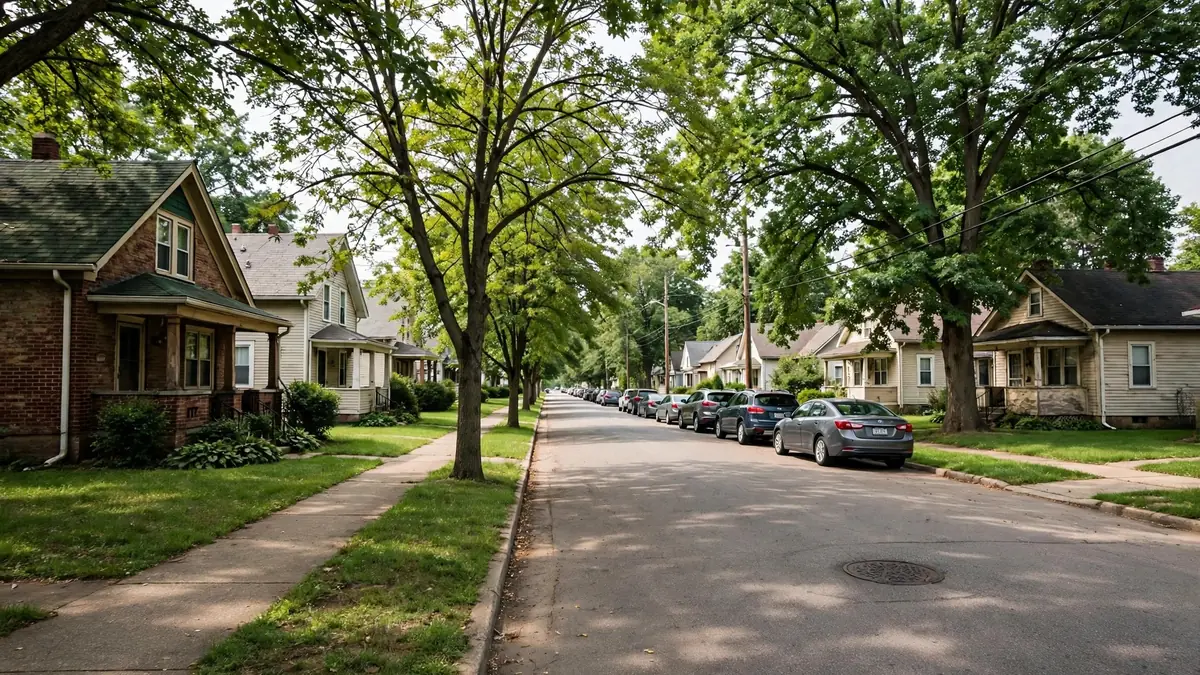
Away from the commercial strip, Broad Ripple's residential streets are mostly smaller older homes: cottages, bungalows and modest two-story houses on fairly narrow lots, many shaded by large trees. Houses of that era were typically connected with clay pipe, which holds up well between its joints but lets roots in at them [6]. The pattern homeowners see is familiar: drains slowing over months, a gurgling toilet, and eventually water at the lowest drain.
Some Broad Ripple cottages have shallow basements or crawlspaces rather than full basements. In those houses, a blocked lateral may show up first at a first-floor tub or shower instead of a basement floor drain. The cleanout may be outside near the foundation, in a crawlspace, or missing entirely.
Many older homes have been renovated, and kitchens and bathrooms moved or added. Renovation plumbing inside the house is often new, while the lateral outside is still original. A remodel is a good moment to film the lateral too, so new finishes are not damaged by an old pipe's backup.
The village strip
Restaurants, bars and grease in Broad Ripple's commercial lines
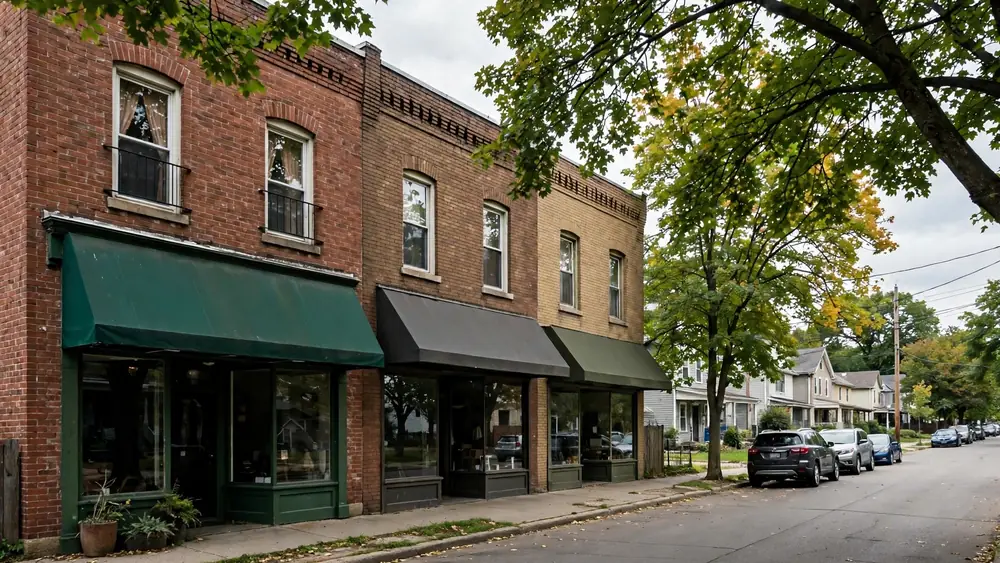
The blocks around Broad Ripple Avenue are lined with restaurants, bars and shops, many in older buildings with apartments upstairs. Kitchens produce grease, and even with grease interceptors some reaches the lateral, where it cools, hardens and binds with other debris. The EPA identifies fats, oils and grease as a leading cause of sewer blockages and overflows [4]. A building's lateral can narrow steadily until a busy weekend finally tips it into a backup.
Commercial lines in older buildings also tend to be longer and may run under sidewalks or into the street to reach the main. When they fail, the repair can involve right-of-way work and coordination with neighboring businesses. Regular jetting and a periodic camera check are the usual way to keep these lines ahead of trouble.
If you manage a mixed-use building, know where every cleanout is, which tenants share which lines, and when the grease interceptor was last serviced. Those three facts make every call faster.
Canal and river
The Central Canal, the White River and Broad Ripple basements
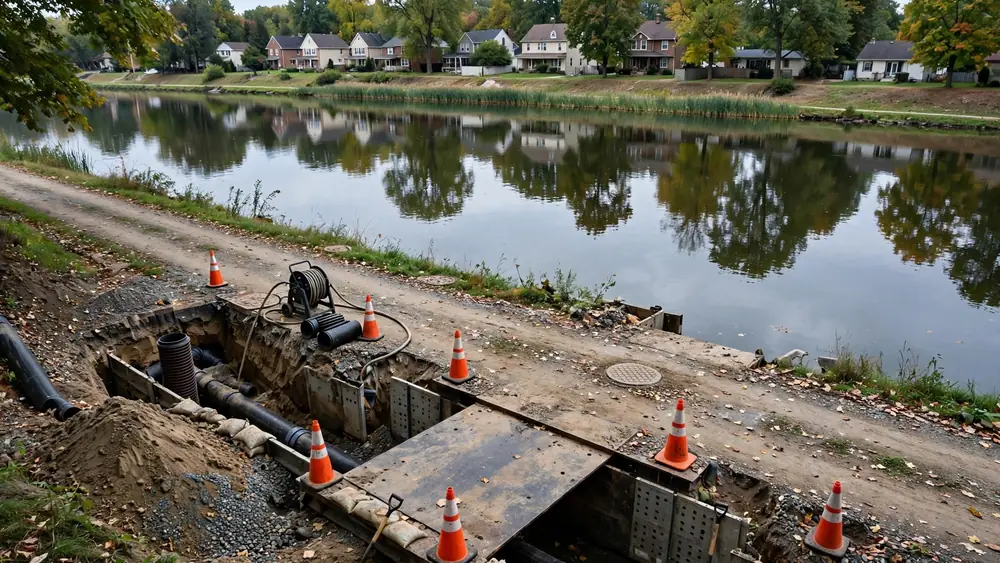
Broad Ripple sits between two bodies of water: the Central Canal, which runs through the neighborhood, and the White River, which bends along its northern and eastern edge with Broad Ripple Park on its bank [3]. Neither one connects to your sewer, but they shape the ground. Areas near water tend to have higher groundwater and softer soils in places, and streets slope down toward the river.
Higher groundwater can seep into cracked laterals, adding clear water to the sewer and sometimes carrying soil into the pipe. On camera, that shows up as water entering at joints or cracks and as sediment on the bottom of the pipe. Softer soils can let sections settle and form sags.
Storms add their own pressure. Older parts of Indianapolis rely on combined sewers that can fill in heavy rain [7], and Citizens Energy Group's DigIndy tunnels were built to capture overflow that once spilled into the river and streams [2]. If your basement backs up only in big storms, especially in a low spot, ask about a backwater valve.
A typical job
How a Broad Ripple sewer call usually goes
- 1
Find the access point
Basement, crawlspace or outside cleanout, or a toilet if nothing else exists.
- 2
Open the line
A cable for a sudden blockage; a jetter where grease is suspected.
- 3
Film the lateral
The camera records roots, grease, cracks, sags and any transition from new to old pipe.
- 4
Locate the problem
Defects are marked on the ground, which on narrow lots may mean next to a fence line or driveway.
- 5
Plan the fix
Cleaning, lining, bursting or a dug repair, chosen from the video.
- 6
Permit, locates and inspection
Repairs and lining run through a Citizens permit and an Indiana 811 locate request [1][5].
Property types
Broad Ripple property types and sewer patterns
| Property | Common setup | Typical problem |
|---|---|---|
| Older cottage or bungalow | Clay lateral, small lot, trees | Roots at joints, slow drains |
| Renovated older house | New interior plumbing, original lateral | Old lateral fails after remodel |
| Restaurant or bar | Long commercial line, grease interceptor | Grease narrowing, weekend backups |
| Apartments above shops | Shared lateral for several units | One blockage affects many tenants |
| New townhouse or apartment | New pipe tied into older main connection | Issues at the tap or transition |
| Home on a low lot near the river | Lateral below nearby grades | Storm-related backflow |
Before the visit
Getting ready for a sewer contractor in Broad Ripple
- Find the cleanout; in houses without basements, check outside near the foundation and in any crawlspace.
- Plan parking: Broad Ripple streets fill up, especially near the village on evenings and weekends.
- For commercial buildings, note when the kitchen is busiest and schedule work around it.
- Tell tenants above a shop when the line will be out of service.
- Have grease interceptor service records ready for restaurant lines.
- Mention whether backups happen on dry days or during storms.
- Share any earlier camera video, especially from a renovation or purchase.
Choosing a repair
Broad Ripple repair options by property
For older residential laterals with roots at the joints, the choice usually comes down to lining or replacement. Narrow lots, tight side yards and mature trees often favor trenchless repair, which needs much less room than a trench. Where the camera finds a sag, that section is usually dug and relaid.
For commercial lines, cleaning is often the first answer, followed by repair when the camera finds structural damage. Lining is common for commercial laterals because it avoids closing sidewalks or storefronts for long, but the pipe has to be cleaned thoroughly of grease first or the liner will not bond.
On redeveloped lots, problems often appear where new pipe meets old: at the property line or at the old tap. Those may need a short excavation at the connection, coordinated with Citizens for the inspection [1].
Renters and landlords
Sewer backups in Broad Ripple rentals
Broad Ripple has a large rental market, from apartments over shops to houses shared by roommates. In most rentals, the owner arranges and pays for sewer work, and the tenant's job is to report problems promptly and stop using water when a backup starts. Tenants should report in writing, with photos, so there is a clear record.
Landlords with several older properties in the area often find that a short list of laterals causes most of their calls. Filming those lines and fixing the worst ones usually means less disruption over time than repeated emergency clearing, and it keeps tenants from living with repeated backups.
Prevention
Keeping Broad Ripple drains running
- Restaurants: keep grease interceptors serviced on schedule and train staff to scrape plates into the trash.
- Homes: wipe greasy pans before washing and use sink strainers.
- Post a simple note in rentals: only toilet paper in the toilet.
- Schedule jetting for commercial lines before they narrow enough to back up.
- Have older residential laterals filmed before spring if roots have been a problem.
- Consider a backwater valve for low-lying basements with storm backups.
Nearby
Neighborhoods around Broad Ripple
Just south, Meridian-Kessler has larger 1920s and 1930s houses with big trees over clay laterals. To the southwest, Butler-Tarkington shares the Central Canal and similar-era housing.
Infill and redevelopment
New buildings on old Broad Ripple sewer connections
Broad Ripple has seen a lot of redevelopment: older houses replaced by townhouses, small lots combined for apartment buildings, and commercial buildings rebuilt or expanded. New construction comes with new plumbing inside, and usually a new lateral at least to the property line. What it sometimes inherits is the old connection point at the main, or an older section of pipe in the right-of-way.
Owners of newer buildings are often surprised to have sewer trouble at all. When they do, the camera frequently finds it at a transition: a new PVC line meeting an older clay stub, a connection to the main that was reused, or a joint between the two that has settled. These are usually short repairs, but they may be in the sidewalk or street, which means right-of-way work in addition to the Citizens permit [1].
If you own a newer townhouse or condo, ask the association or builder for any records of the sewer connection. Knowing whether the tap was replaced during construction saves time when a problem appears.
Condos and associations
Who handles sewer lines in Broad Ripple condos and townhouses
In condominium and townhouse communities, the lateral may serve several units and may be a common element maintained by the association rather than any one owner. The governing documents usually say who is responsible for which pipes. Inside a unit, the owner is typically responsible for fixtures and branch drains; shared building drains and the lateral to the main often fall to the association.
When a backup happens, report it to the association or manager right away, along with which units are affected. Associations that keep a map of cleanouts and a record of past inspections can direct a contractor straight to the right access point, which shortens the time everyone is without plumbing.
Telling it apart
Is it a Broad Ripple building problem or a single unit?
- One fixture slowA single slow sink or tub in one unit is usually that unit's branch drain.
- One unit backing upWater rising in the lowest unit's drains while others run water points to the shared line.
- Every unit affectedSeveral units with slow drains at once is a building drain or lateral problem.
- Only during stormsBackups that line up with heavy rain may come from the public sewer.
- Only at the kitchenA restaurant or kitchen-heavy building with a slow line often has grease buildup.
Seasonal patterns
When Broad Ripple sewer calls peak
Residential root problems tend to peak in spring as trees push new growth, and again in late summer droughts. Commercial grease problems are more tied to activity: busy holidays, festivals and weekends put the heaviest loads on restaurant lines. Heavy spring and summer storms bring storm-related backflow in low spots. Planning maintenance ahead of each pattern, rather than after a backup, is the simplest way to avoid trouble.
Narrow lots
Working on Broad Ripple's narrow lots and side yards
Many residential lots in Broad Ripple are narrow, with houses close together and little room down the side. That matters for sewer work. An excavator may not fit between houses, spoil piles have to go somewhere, and a trench across the front yard can block the only path to the door. Fences, garages and driveways often sit right where a trench would want to go.
Those constraints are why trenchless methods are so common here. CIPP lining can be done from a cleanout with no excavation at all, and pipe bursting needs only two small pits. When digging is unavoidable, contractors often use mini-excavators or hand-dig short sections, and they plan where soil will be stored before starting.
Talk to your neighbors before a project if equipment or a pit will be close to the property line. A quick conversation about parking, noise and access avoids friction in a neighborhood where everyone lives close together.
Buying here
Sewer checks when buying in Broad Ripple
Whether you are buying an older cottage, a renovated bungalow or a newer townhouse, ask for any sewer records and consider a separate sewer scope. Older homes may have original clay; newer ones may have a transition to an older connection. Either way, knowing before closing is far better than finding out at the first backup.
Interceptors
Grease interceptors on Broad Ripple restaurant lines
A grease interceptor, sometimes called a grease trap, slows kitchen wastewater so fats float and solids settle before the flow reaches the lateral. It only works when it is pumped and cleaned on schedule. An overdue interceptor passes grease straight into the line. When a restaurant lateral keeps narrowing, the interceptor's service log is one of the first things a contractor will ask to see, and fixing the maintenance schedule often does more than any single jetting visit.
FAQ
Broad Ripple sewer questions
Why do Broad Ripple restaurant drains back up so often?
Grease from kitchens cools and hardens inside the line, narrowing it over time. Combined with older pipe and heavy weekend use, that leads to backups. Regular jetting and interceptor maintenance help.
Who fixes the sewer for an apartment over a Broad Ripple shop?
Usually the building owner arranges it, since the lateral from the building to the main is the owner's responsibility under Citizens Energy Group's rules. Tenants should report problems to the landlord in writing.
Does living near the White River affect my sewer?
It can. Areas near water may have higher groundwater and softer soils, which can seep into cracked laterals or let sections settle. Low lots can also be more sensitive to storm-related backflow.
My Broad Ripple house has no basement. Where is the cleanout?
Look outside near the foundation, in a crawlspace, or near where the main drain leaves the house. If there is none, a contractor may access the line through a toilet and recommend adding a cleanout.
Can a liner be used in a commercial line with grease?
Yes, once the pipe has been thoroughly cleaned so the liner can bond. Grease left on the wall prevents a good bond.
Is Broad Ripple's ZIP code covered?
Yes, 46220 is covered, along with many surrounding north-side ZIP codes. Calling is the quickest way to confirm your address.
Do I need a permit to repair a Broad Ripple sewer lateral?
Yes for repairs, replacements, cleanouts and lining. Routine cleaning and root removal do not need one under Citizens Energy Group's rules.
Why did my renovated Broad Ripple house have a sewer backup?
A remodel often replaces interior plumbing but leaves the original lateral outside. If that old line has roots or cracks, it can back up into the new finishes. Filming it during the renovation helps.