Key facts: Pipe Bursting
- Pipe bursting fractures the existing pipe with a bursting head and pulls a new pipe in behind it along the same route [2].
- The new pipe for house laterals is usually high-density polyethylene joined by heat fusion, which leaves no joints for roots.
- In Indianapolis, replacing a lateral by any method requires a Citizens Energy Group permit and an inspection before backfill [1].
- Bursting follows the old pipe's path, so it does not correct a sag; those sections are usually dug and relaid.
How it works
Splitting the old pipe and pulling in the new one
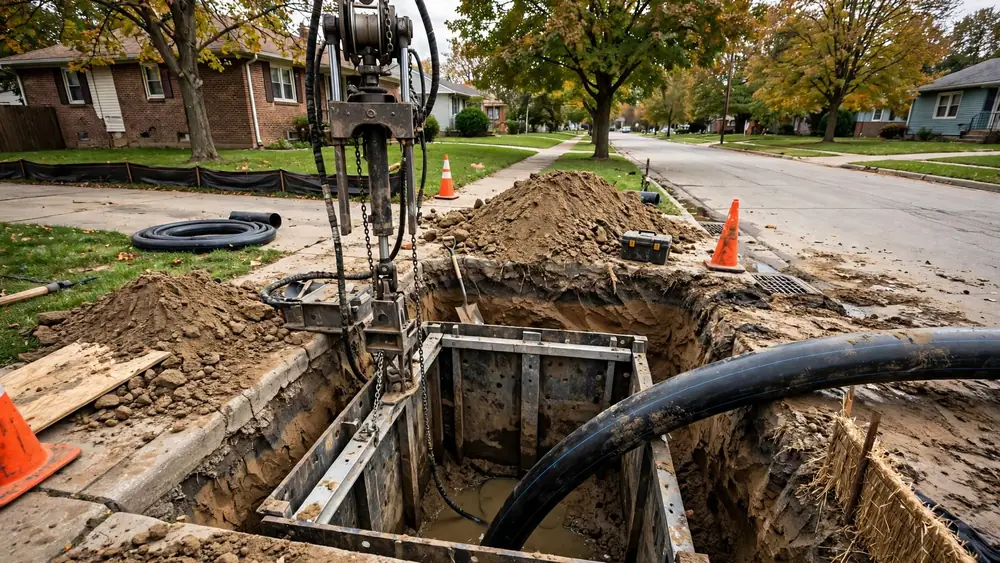
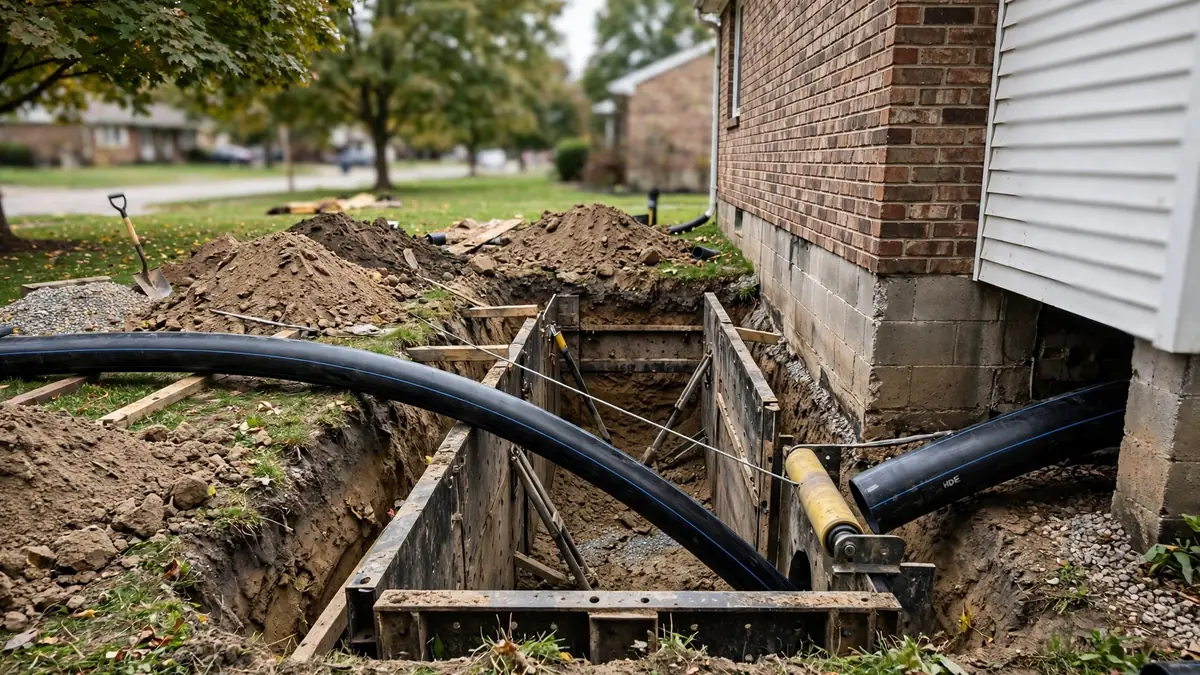
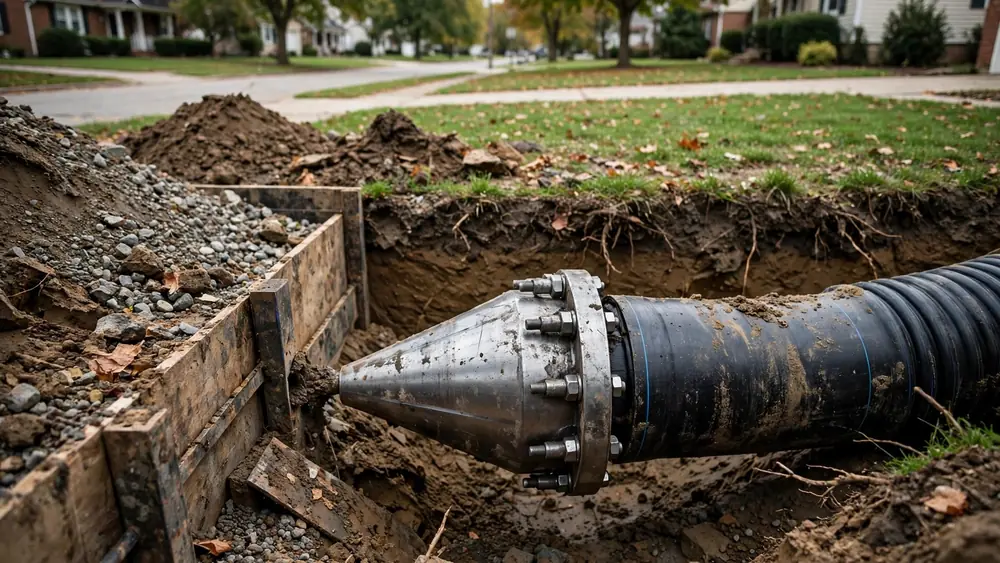
Pipe bursting starts with two pits: a launch pit at one end of the lateral, often near the house, and a receiving pit at the other, often near the curb or at the connection to the main. A steel cable or a string of rods is fed through the old pipe from the receiving pit to the launch pit. The bursting head, a cone wider than the old pipe, is attached at the launch end with the new pipe fixed behind it.
A hydraulic puller at the receiving pit then draws the cable back. As the cone moves through the old pipe, it cracks clay, fiber or cast iron into pieces and pushes the fragments outward into the surrounding soil [2]. The new pipe, connected directly behind the head, slides into the space the old pipe used to occupy. Some systems use pneumatic heads that hammer forward as well; on house laterals static pull systems are common.
When the head reaches the receiving pit, the full length of new pipe is in place. The crew trims the ends, connects them to the house drain and the main or a short new connector, and the work is inspected before the pits are filled. Because the new pipe is a single fused piece from one pit to the other, there are no joints for roots to find along the way.
Good fits
Lateral conditions where bursting works well
Flattening fiber pipe
Orangeburg-style pipe that has gone oval cannot hold a liner, but it bursts easily [4].
Clay with roots at every joint
Replacing the whole run removes every joint at once instead of sealing them one by one.
Undersized laterals
A bursting head can open the path enough to pull in a slightly larger pipe.
Features above the line
Steps, porches, mature trees and driveways can stay put with pits placed on either side.
Fairly straight routes
Bursting works best on runs without sharp bends between the two pits.
Cracked cast iron
Cast iron can be burst with suitable heads, often with cutting blades for the tougher material.
Why bursting
Why bursting suits so many older Indianapolis laterals
Much of Indianapolis was built in two big waves that left two kinds of tired sewer pipe. The first, from the late 1800s to the 1930s, used vitrified clay in short sections [5]. The second, the post-war boom of the late 1940s through the 1960s, often used bituminized fiber pipe because it was light, easy to handle and quick to lay [4]. Both are now reaching the end of their working life in large numbers.
Clay with roots at its joints can often be lined, but fiber pipe usually cannot. As it ages, fiber pipe absorbs moisture, softens and gradually loses its round shape under the weight of the soil. A liner needs a round host pipe to press against, and a bladder cannot reliably push a deformed fiber pipe back into shape. Bursting does not care about the old pipe's shape: it breaks whatever is there and replaces it.
Bursting also solves the problem of mixed materials. A lateral that starts as cast iron at the foundation, changes to clay under the yard and has a section of fiber pipe that someone repaired decades ago can be replaced in one pull, as long as the head can get through.
Feasibility
How a contractor checks a line for bursting
- 1
Film the full lateral
A sewer camera inspection shows length, bends, materials and any collapsed spots.
- 2
Confirm a cable can pass
If the old pipe is completely collapsed, the pulling cable may not get through without a pit at that spot.
- 3
Look for sags
Bellies with standing water will reappear in the new pipe unless that section is excavated.
- 4
Map nearby utilities
Gas, water and communication lines close to the sewer can be damaged by the bursting forces, so locates and clearances matter [3].
- 5
Choose pit locations
Pits go where the line can be reached and where they disturb the least: beside steps, in lawn, near the curb.
- 6
Check the connection
If the tap at the main is damaged, a separate excavation at the street is planned.
When it fits
Bursting, lining or digging by lateral condition
| Condition | Bursting | Comment |
|---|---|---|
| Deformed fiber pipe | Good fit | Liner can't hold its shape in it |
| Clay with joint roots | Good fit | Lining is also an option |
| Pipe needs to be larger | Good fit | Head opens the path for a bigger pipe |
| Long sag in the run | Poor fit | New pipe follows the sag; dig it out |
| Fully collapsed section | Sometimes | Pit may be needed to get the cable through |
| Gas or water line very close | Use caution | May need hand-digging or another route |
| Sharp bends | Poor fit | Extra pits or a dug section at the bend |
The job
How a pipe bursting replacement is done
- 1
Permit and utility marks for both pits
The contractor gets the Citizens Energy Group permit and calls Indiana 811 before digging [1][3].
- 2
Dig the pits
A launch pit and a receiving pit are excavated, with shoring if deep.
- 3
Fuse the new pipe
Lengths of HDPE are heat-fused into one continuous pipe laid out on the lawn or street.
- 4
Thread the cable
The pulling cable or rods are pushed through the old pipe from one pit to the other.
- 5
Pull and burst
The puller draws the head and new pipe through, breaking the old pipe as it goes.
- 6
Connect both ends
The new pipe is joined to the house drain and the main or connection with approved fittings.
- 7
Inspect, film and backfill
A camera run checks the new line, Citizens inspects, and the pits are filled and restored [1].
Pipe and fittings
What goes into a burst lateral
| Part | Typical material | Role |
|---|---|---|
| Main pipe run | HDPE, heat-fused | Continuous, jointless replacement |
| Connection at the house | Transition coupling to cast iron or PVC | Joins new pipe to the building drain |
| Cleanout | PVC two-way cleanout | Future access for cleaning and cameras |
| Connection at the main | Approved saddle or coupling | Meets the utility's standards |
| Bedding at the pits | Stone or sand | Supports the pipe ends and fittings |
DIY vs pro
The homeowner's role in a bursting job
- Bursting equipment and lateral work are for licensed contractors only under Citizens' rules [1].
- You can tell the contractor about private buried lines the locate won't show: sprinklers, dog fences, lighting, gas lines to a grill or detached garage.
- You can clear space in the yard for the fused pipe to be laid out before it is pulled in.
- You can ask how close the gas service and water line are to the sewer, and how the crew will protect them.
- You can ask to see the camera run of the new pipe before the pits are filled.
- You can check the contractor's plumbing license with the state [6].
- You can warn neighbors if the pulled pipe or equipment will block a shared driveway or sidewalk.
- Stay out of the pits; they can be several feet deep near the street.
The visit
A bursting job from the homeowner's side
Many single-family bursting jobs are completed in a day, sometimes two when pits are deep, the ground is hard or the inspection has to be scheduled. The sewer is out of service from when the old pipe is disconnected until the new one is connected, so plan for no water use for most of the working day.
You will see a length of black pipe laid across the lawn or along the street before it is pulled in. That is normal; it has to be fused into one piece first. The puller and its hydraulic power unit are fairly compact, and the excavator used for the pits is usually a small machine. Noise comes from the excavator and from the power unit while pulling.
Once the new pipe is connected and filmed, the contractor calls for the Citizens inspection. The pits stay open until it passes, then they are backfilled and the surface restored. Compared with an open trench, the yard is left with two patches instead of a long strip.
Local specifics
Bursting a lateral under Citizens Energy Group rules
A pipe bursting job is a replacement, and Citizens Energy Group requires a permit for replacements, repairs, relocations and lining of laterals [1]. Only licensed contractors may do the work, and in Indianapolis they must be registered with the City, with insurance and a bond in place [1]. After the new pipe is connected, the contractor requests an inspection and leaves the pits open until it passes.
On many older Indianapolis streets, the main runs under the roadway rather than in an alley, and the receiving pit may end up at the curb or in the street. Where the existing tap is sound, the new pipe can often be joined to it with a short connection. Where it is damaged, the connection is rebuilt in the street to the utility's standards, which brings its own coordination.
Local soils play a part too. Central Indiana's clay-rich glacial soils are dense, which helps support the new pipe but can make bursting harder work than in sandy ground. Contractors account for this in their choice of head size and pulling equipment.
The new pipe
Why fused polyethylene is used for bursting
High-density polyethylene is tough, flexible and can be joined by heat fusion, which melts the ends of two pipes together into a joint as strong as the pipe itself. That makes it ideal for bursting: it can bend slightly to follow the path, withstand the pulling forces, and arrive in place as a single piece with no gaps. For a homeowner who has fought roots at clay joints for years, a jointless pipe is the main attraction.
Polyethylene does not corrode and resists the chemicals in household wastewater. It is also smooth inside, which helps flow. The connection points at each end are where attention is needed, since that is where the new pipe meets old cast iron at the house and the public system at the main.
Prevention
Looking after a new burst line
- Keep the final video and a sketch of where the pits were.
- Use the new cleanout for any future cleaning so equipment goes straight down the line.
- Keep grease and wipes out of the drains.
- Watch the pit areas for settlement for a few months and top up the soil.
- Avoid planting large trees directly over the route.
- If storms have caused backups before, ask about adding a backwater valve while a pit is open near the house.
Choosing
Bursting compared with lining and open trench
If the camera shows a round clay pipe with roots at the joints, cured-in-place lining and bursting can both work; lining may need less digging, while bursting gives an entirely new pipe and can increase the diameter. If the old pipe is deformed fiber, bursting is usually the better trenchless option. If the line has sags, open-trench work is needed for those sections, whatever method is used elsewhere.
The parent page on sewer line replacement explains open-trench replacement in more depth, and the trenchless vs excavation guide compares the approaches side by side.
Pit placement
Where the two pits usually go on an Indianapolis lot
On a typical older city lot, the launch pit is dug a few feet out from the front foundation wall, where the lateral leaves the basement. That spot is usually lawn or a planting bed, and it is close enough to the house that the new pipe can be joined to the cast iron building drain with a short transition. If the front of the house has a porch or steps over the line, the pit goes to one side and the connection is angled in.
The receiving pit depends on where the main is. Where the main runs under the street, the pit is often at the curb or in the tree lawn, with the final connection made under the pavement. Where houses back onto an alley with a sewer in it, the whole job shifts to the backyard. The camera locate tells the contractor exactly where the line runs and how deep it is at each end, which is what decides how big each pit has to be.
Ask to see the planned pit locations marked on the ground before work starts. If a pit would land on something you care about, such as a favorite shrub or a newer section of walk, there is sometimes room to move it a few feet.
On the call
Information that helps plan a bursting job
- Previous inspection footageAn inspection showing material and defects lets the contractor judge feasibility quickly.
- What sits over the linePorch, steps, driveway, trees, fences or a garden along the route.
- Where the main isStreet, alley or rear easement, if you know; neighbors' past work can be a clue.
- Other buried linesGas service location, sprinkler systems, buried electric to a garage or lamp post.
- How the house is usedSingle family, double or apartments, which affects scheduling the shutdown.
Old pipe left behind
What happens to the broken pieces underground
The fragments of the old pipe stay in the soil around the new one. Clay and cast iron pieces are inert, and fiber pipe fragments are compressed into the ground. They do not affect the new pipe in normal conditions. Sharp cast iron shards can scratch the outside of the new pipe as it is pulled, which is why contractors choose wall thicknesses and heads suited to the old material, and sometimes pull a protective sleeve with the new pipe through cast iron sections. If you ever dig near the line later, expect to find broken pieces of the old sewer alongside the new pipe; that is normal and not a sign of a problem.
After the pull
Checking the new line before the pits close
Before backfill, a camera run through the new polyethylene should show a smooth, continuous wall from the house connection to the main, with no water standing in low spots and clean, aligned fittings at each end. Ask to watch it or receive the file.
Timing
Planning a bursting job around the seasons
Bursting can be done most of the year, but frozen ground makes digging pits slower and wet spring soil can make them muddy and unstable. If the line is still working, scheduling for drier months is sensible.
Related problems
Problems that often lead to a bursting job
Most bursting jobs follow years of root clearing, a basement backup, or a camera inspection that found pipe beyond repair. For early signs that a lateral is failing, see signs of a broken sewer line.
FAQ
Pipe bursting questions for Indianapolis homeowners
What is pipe bursting?
It is a trenchless way to replace a pipe. A bursting head breaks the old pipe apart underground while a new pipe, usually fused polyethylene, is pulled in behind it along the same path.
How many holes does pipe bursting need?
Usually two: a launch pit and a receiving pit. Extra pits may be needed at a sharp bend, a collapse the cable cannot pass, or a damaged connection at the main.
Is pipe bursting better than lining?
It depends on the pipe. Bursting gives a brand new pipe and handles deformed fiber pipe, while lining may need less digging on a round, sound host pipe. The camera video decides which fits.
Can pipe bursting fix a sagging sewer line?
No. The new pipe follows the old path, sag included. Sections with bellies are normally dug up and relaid at the right slope.
Does pipe bursting need a permit in Indianapolis?
Yes. It is a lateral replacement, so Citizens Energy Group requires a permit and inspects the work before the pits are backfilled.
Can bursting damage my gas line?
It can if a gas or water line runs very close to the sewer, which is why utilities are located first and pits are placed with care. Contractors may hand-dig to expose nearby lines.
How long does a burst sewer line last?
Heat-fused polyethylene pipe is designed for a very long service life, typically many decades. The connections at each end should be installed and inspected carefully.
Can a larger pipe be installed by bursting?
Often yes. The bursting head opens the soil enough to pull in a pipe the same size or somewhat larger than the old one, within the limits of the equipment and ground conditions.