
Key facts: Sewer Camera Inspection in Irvington
- Irvington was laid out in 1870 with winding streets and joined Indianapolis in 1902 [2].
- Laterals of that era were usually vitrified clay in short lengths, with joints roots can enter [3].
- A camera inspection is diagnosis only; Citizens Energy Group requires permits for repairs and lining that may follow [1].
Why scope here
What a camera tends to find under Irvington lots
Most Irvington inspections start in a basement, at a cast iron cleanout near the front foundation wall that may not have been opened since the house changed hands. From there the camera follows the building drain out through stone or brick footings and into the lateral. In houses from the town era, that lateral is often clay laid in two- or three-foot sections [3], and the video shows a joint every few feet, many with fine roots hanging from the seam.
The second common finding is mixed pipe. A century of owners means sections replaced after a backup, a PVC patch where a porch was rebuilt, or an old repair coupling. The camera records each transition and its footage, which tells you whether the remaining original pipe is the weak link. That is the information a general home inspection never gets to.
Winding streets
Why route-finding matters on Irvington's curved blocks
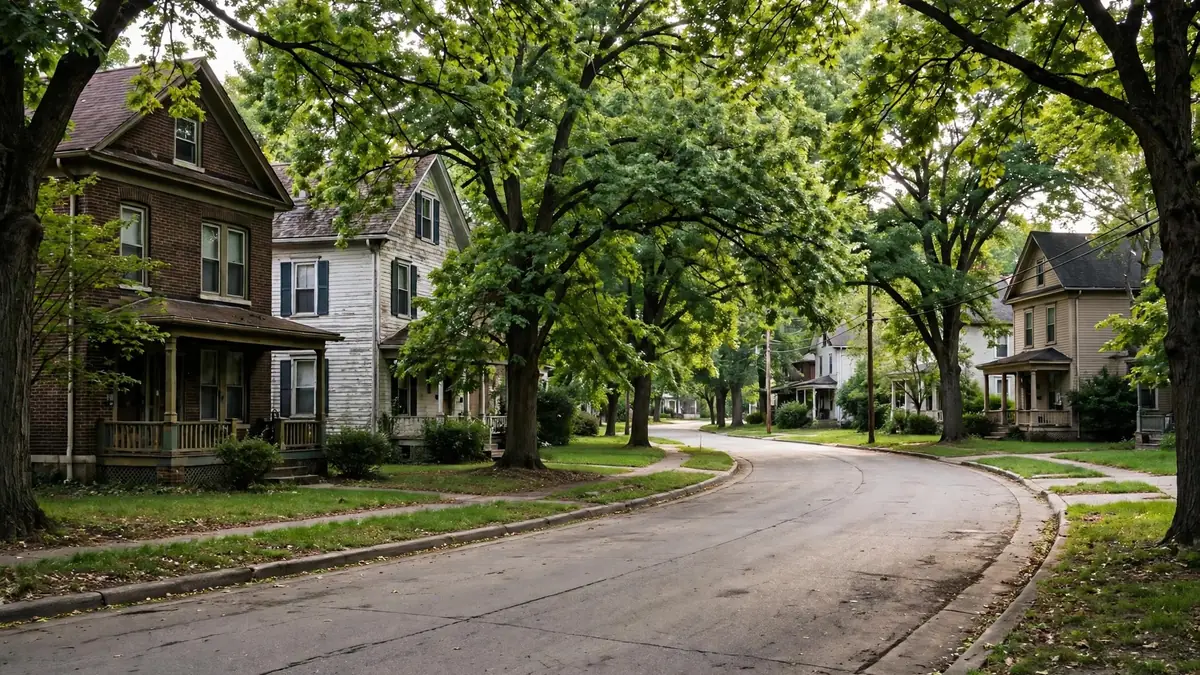
Irvington was deliberately platted with naturalistic, curving streets rather than the grid used elsewhere in the city [2]. Lots are irregular, houses sit at angles to the curb, and the lateral does not always head straight for the street in front. On some blocks it angles across the yard or joins the main well down the street.
A camera with a locating transmitter answers that question in minutes. The contractor follows the sonde from the surface and paints the route and depth on the lawn. For later decisions, such as where a lining crew sets up or where a bursting pit would go, that map is as valuable as the defect list. Photograph the marks before the next mowing.
Before the visit
Preparing an Irvington house for a sewer scope
- Clear stored items from the basement cleanout and check whether the square plug looks seized.
- Note large trees in the tree lawn and front yard, and roughly where they stand relative to the walk.
- Mention whether the house is a double, so both households hold off on water during filming.
- Find any old invoices for root clearing; they show how long roots have been a problem.
- If you are buying, arrange access through the agent and ask for the video file, not just a summary.
Historic district
Filming before work in a historic district
Irvington has National Register status and a local historic district designation from 2006 [2]. A camera inspection itself changes nothing visible, so it raises no preservation questions. What it does is help you plan any later repair so original brick or limestone walks, steps and street trees are left alone. A line that the video shows is round, with roots only at the joints, is a strong candidate for lining from the basement, with no excavation at all.
If the video does show something that needs digging, such as a sag or a collapsed section, the marks tell you exactly where. That lets you discuss a short targeted excavation instead of a trench across the front yard, and gives you time to ask whether any review applies to the visible features nearby.
After the video
Turning Irvington footage into a decision
Bring the recording to the conversation about next steps. Light roots in a round clay line may only need clearing on a schedule. Roots at most joints usually point to CIPP lining. Deformed or broken sections suggest pipe bursting. A belly holding water needs digging at that spot. Any of those repairs needs a Citizens Energy Group permit and inspection [1].
Keep the file with your house papers. Irvington homes change hands for their character, and buyers increasingly ask about the sewer. A dated video, plus the record of anything you fixed, answers that question before it becomes a negotiating point. The main camera inspection page explains the equipment and process in more detail.
What to ask
Questions to ask after an Irvington sewer scope
- What is the pipe made of?Clay, cast iron, fiber or plastic, and where each material starts and stops.
- How deep is each defect?Depth affects whether a repair is a small pit or something larger.
- Is the connection at the main sound?A damaged tap changes the repair plan.
- Which defects are urgent?Collapses and sags usually are; light roots may not be.
Buying in Irvington
Scoping before you buy in Irvington
Buyers drawn to Irvington's older houses are often surprised to learn the lateral is their responsibility. Ask the seller whether the sewer has been lined, replaced or repeatedly cleared, request any existing video, and book a separate scope during the inspection period. A documented, repaired line is a plus; an original clay line under a large tree is something to understand before closing, not after the first spring backup.
FAQ
Sewer Camera Inspection questions in Irvington
Can a camera reach the street from an Irvington basement cleanout?
Usually, if the line is clear enough and the cable is long enough. On deep or curving lots the run can be long, so mention your lot when you call. Heavy roots may need clearing first.
Does a sewer scope need historic district approval in Irvington?
No. Filming the inside of the pipe changes nothing visible. Questions about review only arise if a later repair would disturb historic walks, steps or other visible features.
My Irvington cleanout plug is rusted shut. Is that a problem?
It is common in older houses. Contractors carry tools for seized plugs, and a cracked fitting may need replacing before the camera goes in, which is worth doing anyway.
Should I scope an Irvington house before buying?
For most houses in the neighborhood it is sensible. Many laterals are original pipe under large trees, and a standard home inspection does not include them.
How long is a typical Irvington lateral?
Short answer: it varies with the lot. Curving blocks and deep front setbacks can make some runs much longer than others; the camera's cable counter measures it.
Will I get a copy of my Irvington sewer video?
Ask before the visit. Most modern systems record to a file or link, and having it lets you get a second opinion and compare future inspections.
Can a camera tell whether a tree is causing the roots in Irvington?
It can show where roots enter, and the locator marks that spot on the ground, which often points clearly to a particular tree.
Is the camera inspection messy in Irvington?
Usually not. The main mess risk is opening a cleanout on a backed-up line, which contractors handle with tarps, buckets and a wet vac.